

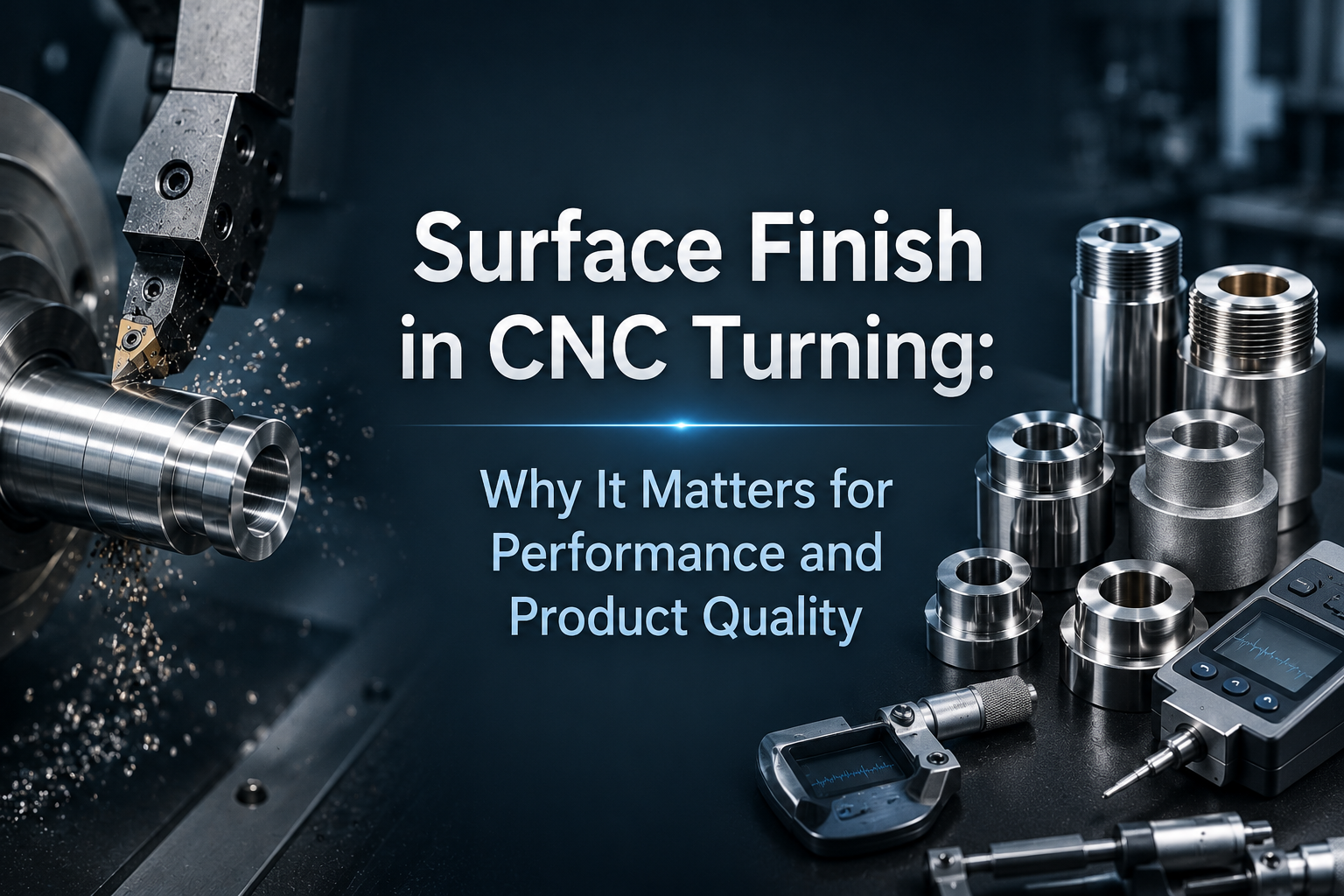
When evaluating the quality of a precision-machined component, dimensional accuracy is often the first specification engineers examine. However, another equally important characteristic is frequently overlooked—surface finish.
Surface finish influences much more than a part’s appearance. It directly affects friction, wear resistance, fatigue life, corrosion resistance, sealing capability, coating adhesion, and assembly performance. In many applications, an excellent surface finish is just as critical as maintaining tight dimensional tolerances.
For manufacturers serving industries such as robotics, aerospace, medical devices, electronics, and industrial automation, controlling surface finish is an essential part of delivering reliable, high-performance components.
What Is Surface Finish?
Surface finish describes the microscopic texture left on a machined surface after manufacturing.
Although a component may appear smooth to the naked eye, magnification reveals a series of tiny peaks and valleys created during the cutting process.
These microscopic irregularities influence how two components interact during operation.
Surface finish is commonly measured using surface roughness (Ra), expressed in micrometers (µm).
Typical examples include:
| Surface Roughness | Typical Application |
|---|---|
| Ra 6.3 μm | General industrial machining |
| Ra 3.2 μm | Standard mechanical components |
| Ra 1.6 μm | Precision shafts |
| Ra 0.8 μm | Bearing seats |
| Ra 0.4 μm | Hydraulic sealing surfaces |
| Ra 0.2 μm | Ultra-precision components |
Lower Ra values indicate smoother surfaces.
Why Surface Finish Matters
A smooth surface improves far more than product appearance.
Its influence extends throughout the entire service life of a component.
Benefits include:
- Lower friction
- Reduced wear
- Improved lubrication
- Better sealing performance
- Longer fatigue life
- Improved corrosion resistance
- Better coating adhesion
- Enhanced assembly accuracy
Even small improvements in surface quality can significantly increase product reliability.
Friction and Wear
Surface finish directly affects friction between moving components.
Examples include:
- Bearings
- Bushings
- Shafts
- Linear guides
- Sliding mechanisms
Excessively rough surfaces create:
- Higher friction
- Increased heat generation
- Faster material wear
- Reduced efficiency
Conversely, excessively polished surfaces are not always desirable.
Some lubrication systems require microscopic surface texture to retain lubricating oil.
Engineers therefore specify the optimal surface finish for each application rather than pursuing the lowest possible Ra value.
Sealing Performance
Many CNC-turned components operate within hydraulic or pneumatic systems.
Examples include:
- Hydraulic cylinders
- Valve bodies
- Pneumatic fittings
- Pump shafts
Poor surface finish may create microscopic leakage paths between sealing surfaces.
This can reduce:
- Pressure retention
- System efficiency
- Equipment reliability
Maintaining the specified surface roughness helps sealing materials perform as intended throughout the product’s service life.
Fatigue Strength
Mechanical components subjected to repeated loading eventually experience fatigue.
Surface imperfections often become starting points for microscopic cracks.
Rough machining marks concentrate stress and accelerate crack propagation.
Improved surface finish reduces these stress concentrations, increasing fatigue resistance and extending component life.
This is especially important for:
- Robot joints
- Aerospace components
- Automotive drive systems
- Industrial automation equipment
Corrosion Resistance
Surface texture also influences corrosion behavior.
Deep machining marks may trap:
- Moisture
- Chemicals
- Dust
- Process contaminants
These contaminants can accelerate localized corrosion.
Smoother surfaces are generally easier to clean and provide better corrosion resistance, particularly after anodizing, plating, or passivation.
Surface Finish and Coating Quality
Many machined components receive additional surface treatments.
Examples include:
- Anodizing
- Electroless nickel plating
- Zinc plating
- Powder coating
- Hard chrome
- DLC coatings
Surface finish affects how well these coatings bond to the substrate.
Excessively rough surfaces may create uneven coating thickness.
Overly smooth surfaces may reduce coating adhesion.
Proper machining therefore improves both appearance and coating durability.
Factors That Influence Surface Finish
Achieving consistent surface quality depends on multiple manufacturing variables.
Cutting Tool Geometry
Sharp cutting edges produce cleaner surfaces while reducing built-up edge formation.
Tool Wear
Worn tools often generate:
- Rough surfaces
- Material tearing
- Burr formation
- Poor dimensional consistency
Regular tool replacement is essential.
Cutting Speed
Optimized spindle speeds improve chip formation and reduce vibration.
Feed Rate
Higher feed rates increase productivity but generally produce rougher surfaces.
Manufacturers balance efficiency with quality requirements.
Machine Rigidity
Stable machine structures minimize vibration.
Reduced vibration improves both dimensional accuracy and surface quality.
Material Characteristics
Different materials produce different surface finishes.
For example:
Aluminum generally machines with excellent surface quality.
Stainless steel may generate built-up edges.
Titanium requires carefully optimized cutting parameters.
Engineering plastics demand different tooling strategies to prevent melting or deformation.
Measuring Surface Finish
Visual inspection alone cannot accurately evaluate surface quality.
Manufacturers use specialized instruments such as:
Surface Roughness Testers
These instruments measure Ra, Rz, and other surface parameters using precision contact probes.
Optical Measurement Systems
Modern non-contact systems provide rapid surface evaluation without damaging sensitive components.
Microscopic Analysis
High-magnification imaging allows engineers to evaluate machining marks and identify process improvements.
Surface Finish in Robotics Manufacturing
Robotic systems require exceptional mechanical performance.
Critical applications include:
- Harmonic drive assemblies
- Servo motor shafts
- Bearing seats
- Precision gears
- Ball screw systems
- Linear motion components
Proper surface finish reduces friction while improving positioning accuracy and component life.
As AI robotics continue to advance, demand for high-quality surface machining continues to increase.
Integrating Surface Quality into Quality Assurance
Surface finish should not be treated as a separate inspection item.
Instead, it should form part of a comprehensive quality management system.
An effective quality process includes:
- Incoming material inspection
- First Article Inspection (FAI)
- In-process monitoring
- Surface roughness measurement
- CMM verification
- Optical sorting
- Final inspection
This integrated approach ensures consistent product quality throughout production.
Conclusion
Surface finish is a critical quality characteristic that influences the performance, reliability, and service life of CNC-turned components. While dimensional accuracy ensures components fit correctly, proper surface finish ensures they continue to perform reliably throughout their operating life.
By optimizing machining parameters, maintaining cutting tools, controlling manufacturing processes, and implementing comprehensive inspection systems, manufacturers can consistently produce components that satisfy the demanding requirements of industries such as robotics, aerospace, medical devices, electronics, and industrial automation.
For companies seeking dependable precision manufacturing partners, surface finish should be considered a key indicator of machining capability and overall quality commitment.