

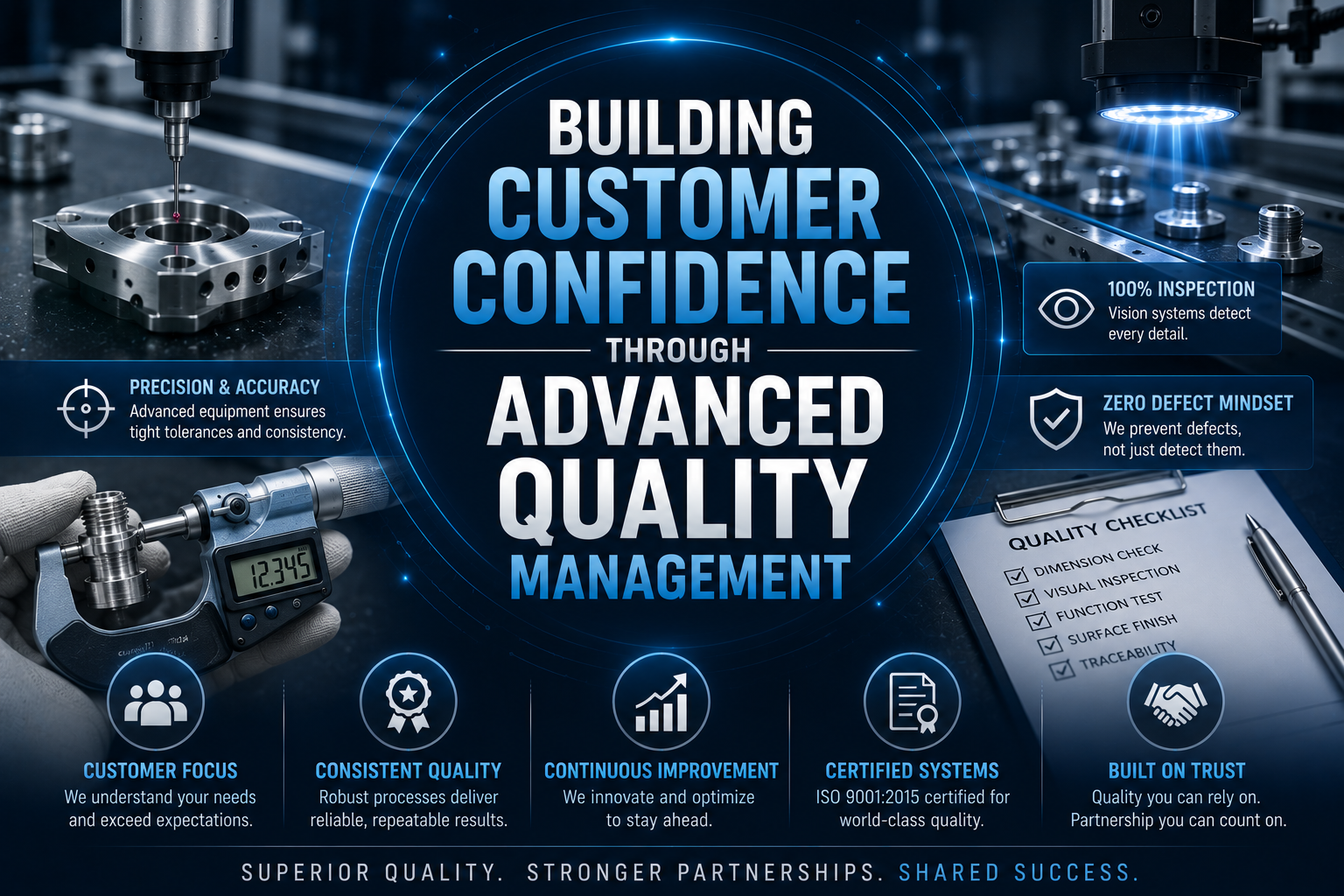
In today’s global manufacturing environment, precision alone is no longer enough to win long-term business. Customers are looking for manufacturing partners who can consistently deliver high-quality products, meet demanding schedules, communicate effectively, and continuously improve their production capabilities.
For OEMs and international buyers, selecting a CNC precision machining supplier involves much more than comparing prices. They evaluate manufacturing experience, technical expertise, quality management systems, inspection capabilities, production stability, and overall reliability.
Advanced quality management has therefore become one of the most important competitive advantages for modern manufacturers. It is the foundation that transforms a machining supplier into a trusted long-term manufacturing partner.
Quality Is Built into Every Process
One of the biggest misconceptions about quality is that it can be “inspected into” a finished product.
In reality, quality is established through a series of controlled processes that begin long before machining starts.
Every stage of production contributes to the final result, including:
- Customer drawing review
- Manufacturing feasibility analysis
- Material verification
- CNC programming
- Tool selection
- Fixture design
- Machining operations
- Process inspections
- Final inspection
- Packaging and shipment
When each process follows standardized procedures, manufacturers can significantly reduce variation and improve production consistency.
Instead of relying on corrective actions after defects occur, advanced quality management focuses on preventing problems from developing in the first place.
Consistency Builds Customer Trust
Customers value consistency just as much as precision.
A supplier capable of producing one excellent component is valuable—but a supplier capable of producing thousands of identical components with the same quality is far more valuable.
Consistency means that customers can expect:
- Stable dimensional accuracy
- Uniform surface finishes
- Reliable assembly performance
- Consistent delivery schedules
- Repeatable production quality
This level of reliability reduces incoming inspections, minimizes production interruptions, and allows customers to focus on their own manufacturing operations with greater confidence.
Traceability Enhances Transparency
As manufacturing supply chains become increasingly complex, traceability has become an essential element of quality management.
Customers often require manufacturers to provide clear production records that demonstrate how each component was produced and inspected.
A comprehensive traceability system may include:
- Material certificates
- Batch identification
- Machine production records
- Operator information
- Inspection reports
- Calibration records
- Process parameters
- Final quality documentation
If a quality issue is identified, traceability allows manufacturers to quickly isolate affected products, investigate root causes, and implement corrective actions efficiently.
This transparency strengthens customer confidence while reducing business risks for both manufacturers and buyers.
Advanced Inspection Improves Product Reliability
Inspection technology has evolved significantly in recent years.
Traditional manual inspections remain important, but modern manufacturers increasingly combine manual expertise with automated inspection systems to improve accuracy and efficiency.
Inspection methods commonly include:
- Coordinate Measuring Machines (CMM)
- Digital precision measuring instruments
- Surface roughness testing
- Vision measurement systems
- Optical sorting equipment
- Automated image inspection
Among these technologies, Optical Sorting has become especially valuable for high-volume precision manufacturing.
Using high-speed cameras, intelligent lighting systems, and advanced image processing algorithms, optical sorting systems inspect every individual component with remarkable speed and consistency.
Unlike traditional sampling methods, automated optical inspection enables 100% inspection, ensuring every shipped component meets predefined quality standards.
This additional level of quality assurance is particularly valuable for industries where product reliability is critical.
Continuous Improvement Creates Long-Term Value
Customer expectations continue to evolve.
Manufacturers that remain competitive understand that quality management is not a one-time project but an ongoing commitment to continuous improvement.
Improvement initiatives may include:
- Statistical Process Control (SPC)
- Root Cause Analysis (RCA)
- Corrective and Preventive Actions (CAPA)
- Lean manufacturing practices
- Employee training
- Equipment modernization
- Process optimization
Each improvement may appear small individually, but together they produce measurable gains in productivity, consistency, and customer satisfaction.
Organizations that embrace continuous improvement become more adaptable to changing customer requirements and emerging manufacturing technologies.
Supporting Next-Generation Manufacturing
The manufacturing industry is rapidly moving toward intelligent production environments driven by automation, digitalization, and artificial intelligence.
Modern CNC manufacturers increasingly integrate technologies such as:
- CNC automation
- Industrial robotics
- Smart production monitoring
- Digital quality records
- AI-assisted inspection
- Optical sorting systems
- Manufacturing Execution Systems (MES)
These technologies not only improve operational efficiency but also provide more accurate production data that supports better decision-making and long-term quality improvement.
Advanced quality management provides the framework needed to successfully implement these innovations while maintaining consistent production standards.
Quality Strengthens Business Relationships
Quality management influences much more than product acceptance.
Reliable quality systems help manufacturers:
- Reduce production risks
- Improve communication
- Shorten lead times
- Increase delivery reliability
- Lower overall manufacturing costs
- Enhance customer satisfaction
For customers, these advantages translate into smoother production planning, fewer quality-related disruptions, and greater confidence in their supply chain.
As trust grows over time, business relationships often expand beyond individual projects into long-term strategic partnerships.
Preparing for the Future
The future of precision manufacturing will place even greater emphasis on quality, automation, and digital integration.
Customers will increasingly expect suppliers to demonstrate:
- Stable manufacturing capability
- Complete production traceability
- Data-driven quality management
- Intelligent inspection systems
- Sustainable manufacturing practices
- Continuous technological advancement
Manufacturers that invest in advanced quality management today will be better prepared to meet tomorrow’s challenges while maintaining their competitive position in global markets.
Conclusion
Advanced quality management is far more than a collection of inspection procedures—it is a comprehensive philosophy that guides every aspect of precision manufacturing.
By combining standardized processes, skilled engineering, advanced inspection technologies, complete traceability, continuous improvement, and customer-focused thinking, CNC manufacturers can consistently deliver products that meet the highest quality expectations.
As global industries continue to demand greater precision, shorter lead times, and higher reliability, manufacturers that prioritize quality management will continue to build stronger customer relationships, enhance operational performance, and secure long-term success.