

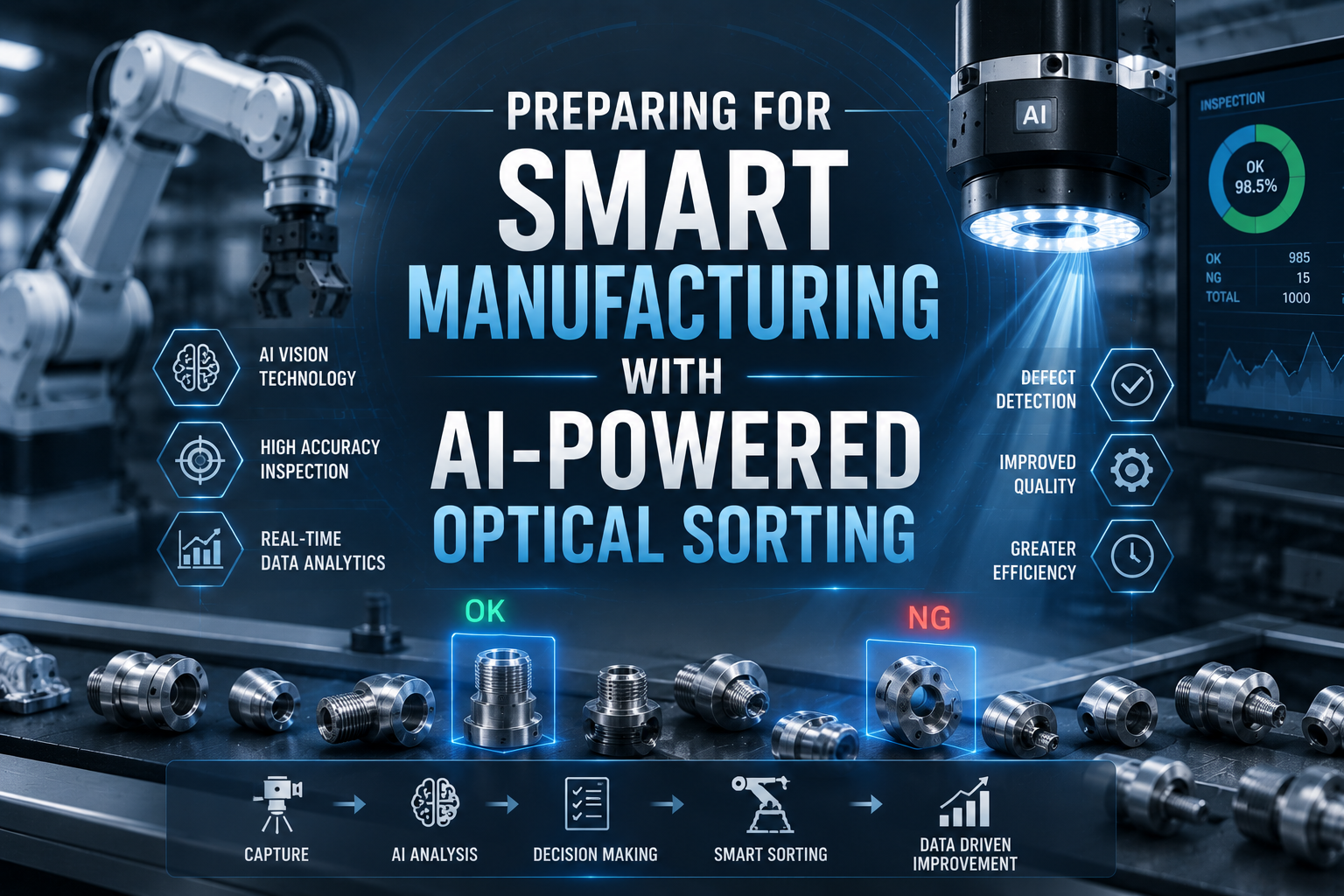
The manufacturing industry is entering a new era driven by automation, artificial intelligence, and digital transformation. What was once considered advanced manufacturing is quickly becoming the industry standard, as companies seek higher productivity, better product quality, and greater operational flexibility.
For CNC precision manufacturers, maintaining a competitive advantage now depends on more than investing in high-performance machining centers. It also requires intelligent quality control systems capable of making faster, more accurate decisions based on real-time production data.
One of the most significant technologies supporting this transformation is AI-powered optical sorting. By combining machine vision, artificial intelligence, automation, and data analytics, manufacturers can move beyond traditional inspection methods and build smarter, more adaptive production environments.
As customer expectations continue to rise, AI-powered optical sorting is becoming an essential part of the smart factory.
From Automated Inspection to Intelligent Inspection
Conventional optical sorting systems follow predefined inspection rules.
For example, a system may reject a component if:
- Diameter exceeds tolerance
- Surface scratch exceeds a specified length
- Hole position falls outside allowable limits
- Thread profile is incomplete
These rule-based systems are highly effective but remain limited to conditions that engineers have programmed in advance.
Artificial Intelligence introduces a new level of capability.
Instead of relying only on fixed rules, AI systems analyze thousands—or even millions—of inspection images to recognize complex defect patterns automatically.
Over time, the inspection system continuously improves its ability to distinguish acceptable products from defective ones.
Inspection becomes increasingly intelligent rather than simply automated.
Deep Learning Improves Defect Recognition
One of the most important AI technologies used in modern vision inspection is Deep Learning.
Traditional image-processing software performs well when inspecting clearly defined features.
However, some manufacturing defects are far more difficult to identify.
Examples include:
- Very small surface scratches
- Slight discoloration
- Irregular machining marks
- Minor deformation
- Complex surface texture variations
- Mixed defect characteristics
Deep learning algorithms can learn these subtle differences by analyzing large collections of inspection images.
Instead of programming every inspection rule manually, engineers train the system using examples of acceptable and defective products.
The result is significantly improved inspection accuracy for complex manufacturing applications.
Real-Time Decision Making
AI-powered optical sorting systems process inspection results almost instantly.
Rather than simply rejecting defective products, intelligent systems can immediately recognize emerging production trends.
Examples include:
- Increasing burr formation
- Progressive tool wear
- Machine vibration
- Thermal expansion
- Fixture instability
- Surface finish deterioration
When abnormal patterns appear, engineers receive early warnings before quality problems become widespread.
This allows production teams to make timely adjustments while minimizing downtime and material waste.
Predictive Quality Management
Traditional quality control often reacts after problems occur.
AI changes this approach by supporting predictive quality management.
Instead of asking:
“Why did defects occur?”
Manufacturers begin asking:
“What conditions indicate defects are about to occur?”
By combining inspection data with production information, AI systems identify relationships between:
- Machine parameters
- Tool life
- Cutting conditions
- Material characteristics
- Environmental temperature
- Historical inspection data
These insights allow manufacturers to predict quality risks before defective products are produced.
Predictive quality management reduces scrap, improves production stability, and lowers overall manufacturing costs.
Continuous Learning Improves Inspection Performance
Unlike traditional inspection software, AI systems continue learning as new production data becomes available.
Every inspected component becomes additional training data.
As production continues, AI gradually improves its ability to recognize:
- New defect types
- Material variation
- Surface texture differences
- Cosmetic imperfections
- Rare manufacturing anomalies
This continuous learning capability enables inspection systems to become increasingly accurate throughout their operational life.
Manufacturers therefore benefit from inspection systems that improve over time rather than remaining static.
Integrating AI with Smart Factories
Modern manufacturing increasingly depends on connected digital systems.
AI-powered optical sorting integrates seamlessly with:
- CNC machining centers
- Manufacturing Execution Systems (MES)
- Enterprise Resource Planning (ERP)
- Industrial Internet of Things (IIoT)
- Statistical Process Control (SPC)
- Production dashboards
- Cloud analytics platforms
These integrations create a continuous flow of information throughout the factory.
Quality data collected during inspection can immediately influence machining parameters, maintenance schedules, and production planning.
Instead of operating independently, inspection becomes an active participant in intelligent manufacturing.
Supporting the Future of AI Robotics
The rapid growth of AI robotics is creating new opportunities for precision manufacturers.
Humanoid robots, collaborative robots (cobots), autonomous mobile robots, and industrial automation systems all require highly precise mechanical components.
Many robotic parts demand:
- Extremely tight dimensional tolerances
- Exceptional surface quality
- Reliable long-term durability
- High-volume production consistency
- Complete quality traceability
Because robotic systems often contain hundreds of precision components, even small manufacturing defects can affect overall system performance.
AI-powered optical sorting helps manufacturers meet these demanding quality requirements while maintaining efficient large-scale production.
As global investment in robotics continues to expand, intelligent inspection technologies will become increasingly important throughout the supply chain.
Creating a Data-Driven Manufacturing Culture
Perhaps the greatest value of AI-powered inspection is not simply detecting defects.
It is transforming manufacturing into a data-driven decision-making process.
Inspection data can be used to evaluate:
- Machine performance
- Production capability
- Tool replacement timing
- Supplier quality
- Process stability
- Operator training effectiveness
- Continuous improvement opportunities
Management decisions become increasingly based on measurable production data rather than assumptions.
This supports smarter investments, improved planning, and stronger long-term competitiveness.
Customer Benefits
Customers increasingly expect manufacturing partners to invest in advanced quality technologies.
AI-powered optical sorting provides several important advantages:
- Higher product consistency
- Faster quality verification
- Reduced defect risk
- Improved traceability
- Stable production quality
- Greater manufacturing transparency
- Enhanced supply chain reliability
These benefits strengthen customer confidence while supporting long-term strategic partnerships.
Manufacturers capable of demonstrating intelligent quality management are often better positioned to compete for high-value international projects.
Looking Ahead
Artificial intelligence will continue transforming precision manufacturing over the coming decade.
Future developments may include:
- Self-optimizing inspection systems
- Fully autonomous quality control
- Digital twin quality simulation
- AI-assisted production scheduling
- Predictive equipment maintenance
- Collaborative robotic inspection
- Cloud-based global quality monitoring
Manufacturers that begin investing today in AI-powered inspection technologies will be better prepared to adapt to these emerging trends.
Building intelligent quality systems today creates the foundation for tomorrow’s smart factory.
Conclusion
AI-powered optical sorting represents the next evolution of quality assurance in CNC precision manufacturing. By combining machine vision, deep learning, predictive analytics, and real-time production monitoring, manufacturers can achieve inspection capabilities that far exceed traditional quality control methods.
Beyond improving defect detection, intelligent inspection enables continuous learning, smarter decision-making, and closer integration with digital manufacturing systems. As industries move toward automation, robotics, and Industry 4.0, AI-powered optical sorting will become an increasingly valuable asset for manufacturers committed to precision, innovation, and long-term customer success.