

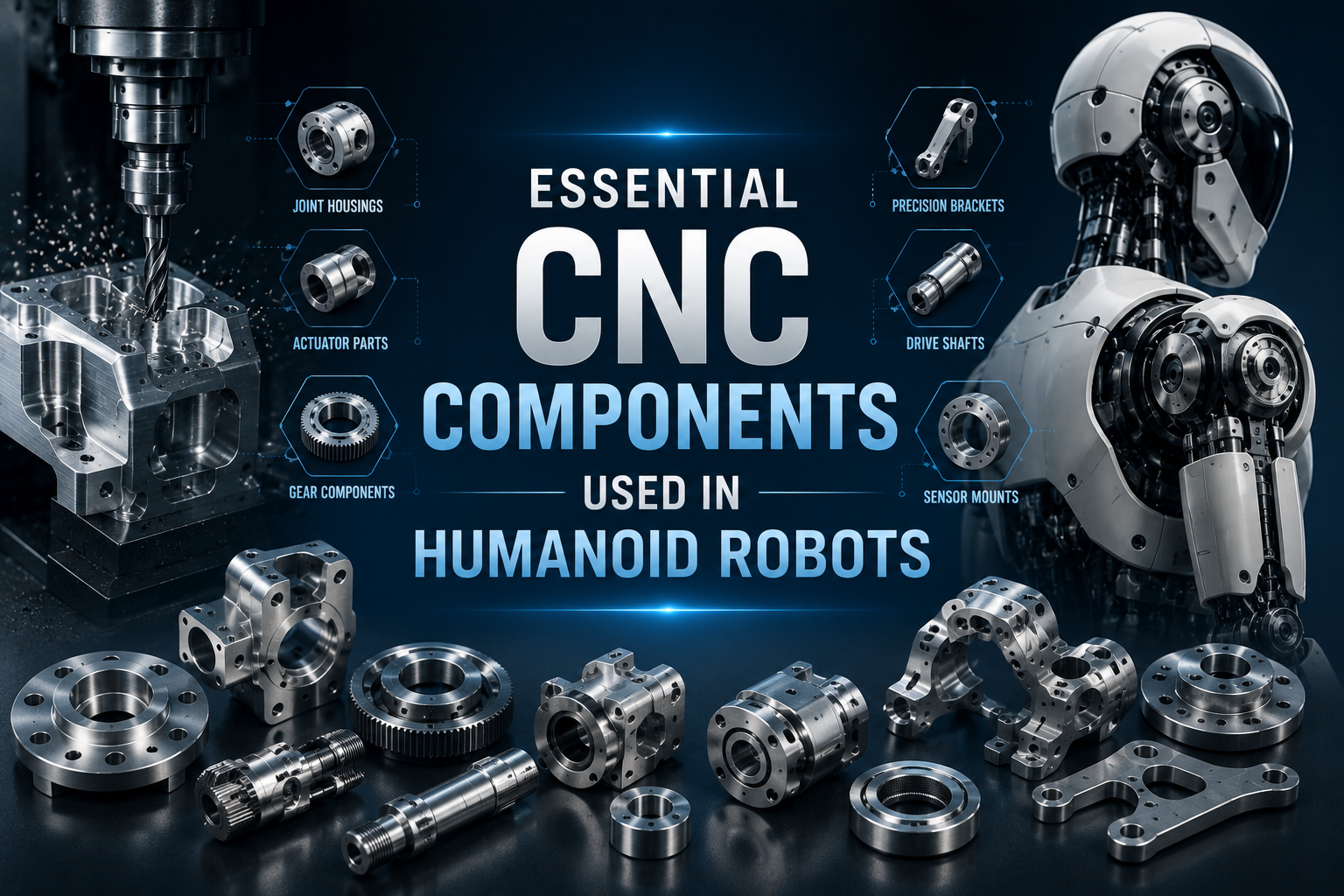
Humanoid robots are rapidly moving from research laboratories into real-world applications. Advances in artificial intelligence, motion control, and sensor technology are enabling robots to perform increasingly complex tasks in manufacturing, logistics, healthcare, hospitality, and service industries.
While AI provides decision-making capabilities, the physical performance of a humanoid robot depends on the quality of its mechanical components. Every movement, balance adjustment, and interaction with the environment requires precisely manufactured parts that work together with exceptional accuracy.
Modern humanoid robots contain hundreds to thousands of mechanical components, many of which are produced using high-precision CNC machining. These components must operate continuously under dynamic loads while maintaining smooth motion, dimensional stability, and long-term durability.
As demand for humanoid robots continues to grow, manufacturers specializing in precision CNC machining are becoming increasingly important partners within the global robotics supply chain.
Why CNC Machining Is Critical for Humanoid Robots
Unlike conventional industrial equipment, humanoid robots continuously perform coordinated multi-axis movements.
Walking, bending, grasping objects, climbing stairs, or maintaining balance all require mechanical systems capable of extremely precise motion.
Every mechanical component influences:
- Motion accuracy
- Structural rigidity
- Weight distribution
- Energy consumption
- Noise levels
- Long-term reliability
Even small dimensional deviations can reduce positioning accuracy or accelerate component wear.
For this reason, robotic manufacturers require CNC-machined parts with excellent repeatability and tight manufacturing tolerances.
Structural Frames and Robot Skeletons
The structural frame acts as the skeleton of a humanoid robot.
It supports motors, gearboxes, electronic systems, batteries, sensors, and protective covers while maintaining overall rigidity.
These structural components typically require:
- High dimensional accuracy
- Lightweight construction
- Excellent strength-to-weight ratio
- Corrosion resistance
- Good machinability
Aluminum alloys are commonly selected because they reduce overall robot weight without sacrificing structural performance.
For high-load applications, steel or titanium components may also be used.
Joint Housings
Every humanoid robot contains multiple articulated joints.
Examples include:
- Shoulder joints
- Elbow joints
- Wrist joints
- Hip joints
- Knee joints
- Ankle joints
Joint housings must precisely locate bearings, shafts, gears, and servo motors.
Important machining requirements include:
- Concentric bearing bores
- Tight positional tolerances
- Flat mounting surfaces
- High rigidity
- Excellent surface finish
Any misalignment within these housings directly affects robot movement and positioning accuracy.
Precision Shafts and Rotary Components
Rotating components are found throughout robotic systems.
Examples include:
- Drive shafts
- Output shafts
- Motor shafts
- Pivot shafts
- Gear shafts
These parts require:
- Excellent roundness
- Precise diameters
- Fine surface finishes
- Controlled hardness
- Low runout
Smooth shaft rotation minimizes vibration while extending bearing life.
Gearbox Components
Most humanoid robots use precision reduction gearboxes to increase torque while maintaining accurate motion.
Typical CNC-machined gearbox components include:
- Gear housings
- Bearing carriers
- Mounting plates
- Output flanges
- Coupling hubs
Because gearbox performance directly influences robot accuracy, dimensional consistency is extremely important.
Poor machining quality can result in increased backlash, vibration, or reduced positioning precision.
Servo Motor Mounting Components
Servo motors generate the movement required by robotic joints.
Motor mounting brackets must provide:
- Accurate positioning
- High rigidity
- Stable alignment
- Efficient heat dissipation
Improper alignment can reduce motor efficiency and shorten service life.
Precision CNC machining ensures reliable integration between motors and transmission systems.
Sensor Mounting Systems
Humanoid robots rely heavily on sensors to perceive their surroundings.
Typical sensors include:
- Cameras
- LiDAR
- Force sensors
- Torque sensors
- IMUs (Inertial Measurement Units)
- Depth cameras
Sensor brackets must position these devices accurately.
Even slight dimensional errors can reduce sensing accuracy and affect navigation or object recognition.
End Effectors
Hands and grippers represent some of the most complex mechanical assemblies within humanoid robots.
Precision CNC machining is commonly used for:
- Finger joints
- Gripper mechanisms
- Tool holders
- Force transmission components
- Linkage assemblies
These components require smooth movement while maintaining sufficient strength for repeated operation.
Lightweight Design Improves Robot Performance
Weight reduction is one of the primary design objectives in humanoid robotics.
Lower weight provides several advantages:
- Lower energy consumption
- Longer battery life
- Faster movement
- Improved balance
- Reduced motor loads
- Greater operational efficiency
CNC machining supports lightweight design through:
- Pocket machining
- Thin-wall machining
- Complex internal structures
- Optimized material removal
Advanced machining techniques allow engineers to reduce weight without compromising structural strength.
Quality Requirements for Robotic Components
Because humanoid robots contain numerous moving assemblies, quality standards are extremely demanding.
Manufacturers commonly implement:
Precision Measurement
Critical dimensions are verified using Coordinate Measuring Machines (CMMs), precision gauges, and optical measurement systems.
Optical Sorting
High-speed optical sorting systems automatically inspect components for:
- Surface defects
- Burrs
- Dimensional deviations
- Missing features
- Cosmetic imperfections
Automated inspection supports consistent product quality while enabling 100% inspection for high-volume production.
Traceability
Manufacturers maintain complete production records including:
- Material certifications
- Inspection reports
- Machine data
- Production batches
- Quality documentation
Traceability provides confidence throughout the robotics supply chain.
Supporting the Future of Robotics
The global robotics industry continues to expand rapidly.
Future applications include:
- Home assistance robots
- Healthcare robots
- Warehouse automation
- Factory automation
- Disaster response robots
- Agricultural robots
- Public service robots
Each application requires increasingly sophisticated mechanical systems supported by high-quality precision manufacturing.
Manufacturers capable of combining CNC machining, advanced inspection technologies, and continuous quality improvement will play an increasingly important role in supporting these emerging industries.
Conclusion
Humanoid robots represent one of the most exciting developments in modern manufacturing and artificial intelligence. Behind every intelligent robot lies a foundation of precisely engineered mechanical components that enable reliable movement, accurate positioning, and long-term durability.
Precision CNC machining remains essential for producing these critical components. From structural frames and joint housings to servo mounts and gearbox assemblies, every machined part contributes to the overall performance of the robot.
As demand for humanoid robotics accelerates worldwide, manufacturers with advanced machining capabilities, rigorous quality assurance, and automated optical inspection will be well positioned to support the next generation of intelligent robotic systems.