

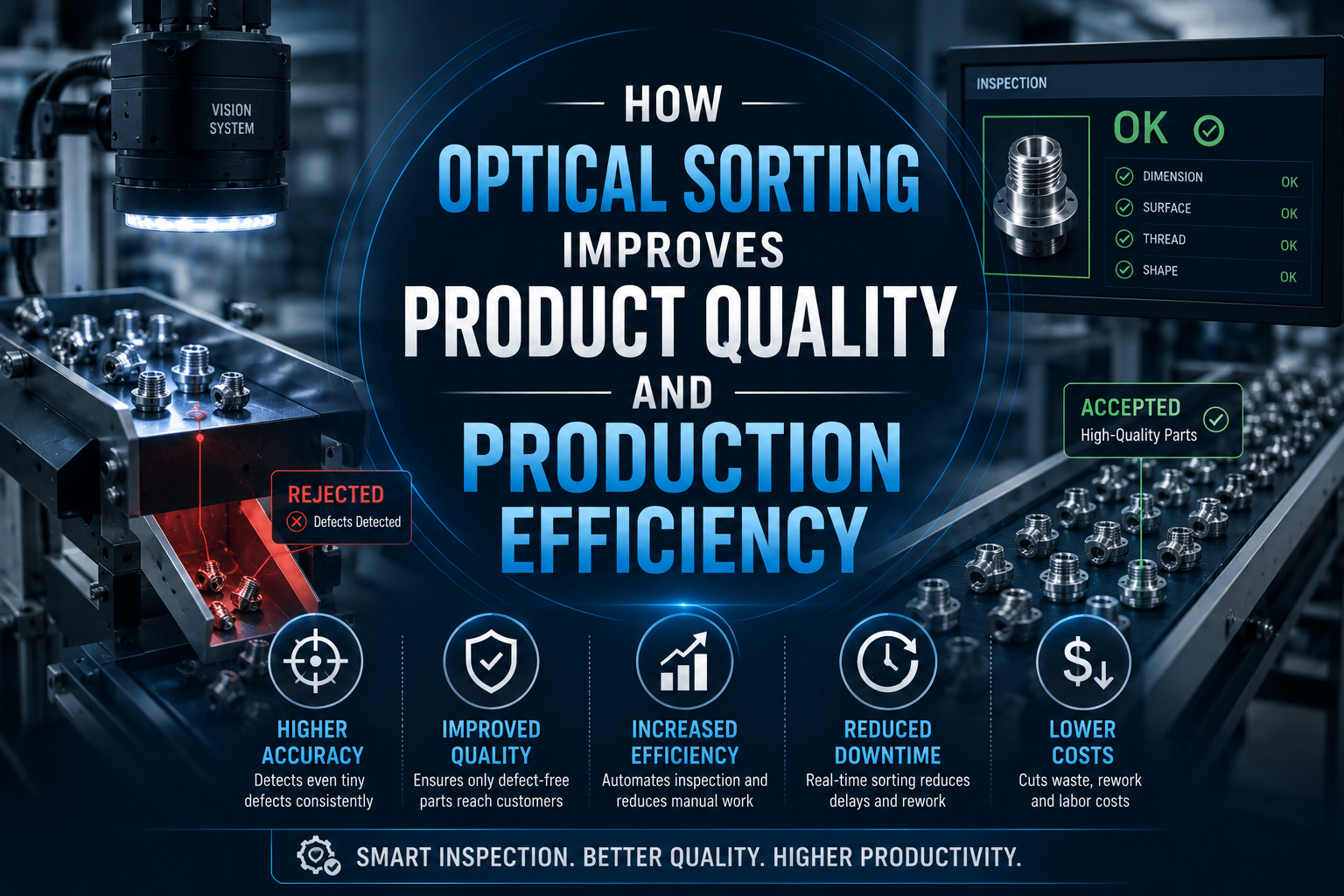
As manufacturing industries continue to pursue higher precision, greater efficiency, and stricter quality standards, inspection technologies have become just as important as machining capabilities. While CNC machines are capable of producing extremely accurate components, ensuring that every finished part meets quality requirements remains a significant challenge—especially in high-volume production.
This is where Optical Sorting has become an essential technology in modern precision manufacturing.
Optical sorting uses high-resolution cameras, intelligent lighting systems, precision optics, and advanced image-processing software to automatically inspect manufactured components. Instead of relying solely on manual visual inspection, optical sorting systems evaluate each part quickly, consistently, and objectively.
For manufacturers producing thousands or even millions of precision components, optical sorting provides an efficient solution for improving product quality while reducing inspection time and human error.
Understanding Optical Sorting
Optical sorting is an automated inspection process that identifies defective products by analyzing images captured during production.
Unlike traditional manual inspection, operators are no longer required to visually examine every component individually.
Instead, parts pass through an automated inspection system where cameras capture multiple images from different angles. Specialized software then compares each image against predefined inspection criteria.
Components that meet specifications continue through production, while defective parts are automatically separated.
This process occurs within fractions of a second, allowing manufacturers to inspect every component without slowing production.
How Optical Sorting Works
Although different systems vary in design, most optical sorting equipment follows a similar workflow.
1. Component Feeding
Finished parts are automatically transported into the inspection system using vibration feeders, conveyor systems, rotary tables, or customized feeding mechanisms.
Stable positioning ensures accurate image capture.
2. Image Acquisition
Industrial cameras capture multiple high-resolution images under carefully controlled lighting conditions.
Depending on product complexity, inspection may include:
- Top view
- Bottom view
- Side view
- Multi-angle inspection
- 360-degree inspection
Lighting is equally important because shadows, reflections, and surface texture all influence image quality.
3. Image Processing
Inspection software analyzes each image using advanced algorithms.
The system evaluates characteristics such as:
- Overall dimensions
- Diameter
- Length
- Hole position
- Thread presence
- Surface scratches
- Burrs
- Cracks
- Missing features
- Shape accuracy
- Surface contamination
Some systems also perform precise dimensional measurements directly from captured images.
4. Automatic Sorting
After inspection, the software determines whether each component meets quality standards.
Qualified products proceed to packaging, while defective parts are automatically rejected without operator intervention.
This creates a fully automated inspection process capable of maintaining consistent quality throughout production.
Why Manual Inspection Has Limitations
Experienced inspectors remain valuable in manufacturing, but manual inspection presents several inherent limitations.
Human inspection performance naturally declines over time due to:
- Fatigue
- Eye strain
- Repetitive work
- Lighting variations
- Subjective judgment
- High production speeds
As production volume increases, maintaining consistent inspection quality becomes increasingly difficult.
Optical sorting eliminates many of these challenges by applying identical inspection standards to every component, regardless of production volume or operating hours.
Supporting 100% Inspection
Traditional quality control often relies on sampling inspection.
While sampling is effective for many applications, it cannot guarantee that every shipped component has been inspected.
Optical sorting changes this approach by enabling 100% inspection.
Every individual component passes through the inspection system before shipment.
This significantly reduces the possibility that defective products reach customers.
For industries requiring exceptional reliability—such as automotive, aerospace, electronics, robotics, and medical manufacturing—100% inspection provides valuable additional quality assurance.
Improving Manufacturing Efficiency
Optical sorting benefits manufacturers in several important ways.
Faster Inspection
Automated systems inspect hundreds or even thousands of parts per minute, dramatically increasing inspection capacity compared to manual methods.
Improved Consistency
Inspection criteria remain identical throughout every production shift.
Unlike manual inspection, there is no variation caused by fatigue or operator experience.
Reduced Labor Requirements
Automation allows skilled employees to focus on process improvement, engineering support, and quality analysis rather than repetitive visual inspection.
Lower Production Costs
Although optical sorting requires an initial investment, reducing defective shipments, minimizing rework, and lowering labor costs often provide significant long-term financial benefits.
Integrating Optical Sorting into Quality Assurance
Optical sorting is most effective when combined with a comprehensive quality management system.
Rather than replacing traditional inspection methods, it complements them.
An integrated quality strategy may include:
- Incoming material inspection
- First Article Inspection (FAI)
- In-process inspection
- Coordinate Measuring Machine (CMM) verification
- Optical sorting
- Final quality audit
Each inspection stage contributes to overall manufacturing reliability.
Together, they create multiple layers of quality assurance that significantly reduce production risks.
Preparing for Smart Manufacturing
As Industry 4.0 technologies continue to transform manufacturing, optical sorting systems are becoming increasingly intelligent.
Modern systems can integrate with:
- Manufacturing Execution Systems (MES)
- Statistical Process Control (SPC)
- Production databases
- CNC machine monitoring
- AI-assisted defect recognition
- Cloud-based production analytics
These digital connections allow manufacturers to monitor quality trends in real time, identify process variations earlier, and continuously optimize production performance.
Optical sorting is no longer simply an inspection tool—it has become an important source of manufacturing intelligence.
Conclusion
Optical sorting has become an indispensable technology in modern CNC precision manufacturing. By combining automated image inspection, intelligent defect detection, and high-speed sorting capabilities, manufacturers can achieve higher product quality, improved efficiency, and greater production consistency.
As customer expectations continue to increase, integrating optical sorting into a comprehensive quality management system enables manufacturers to deliver dependable products while strengthening long-term customer confidence. For companies committed to precision, reliability, and continuous improvement, optical sorting represents a key investment in the future of advanced manufacturing.