

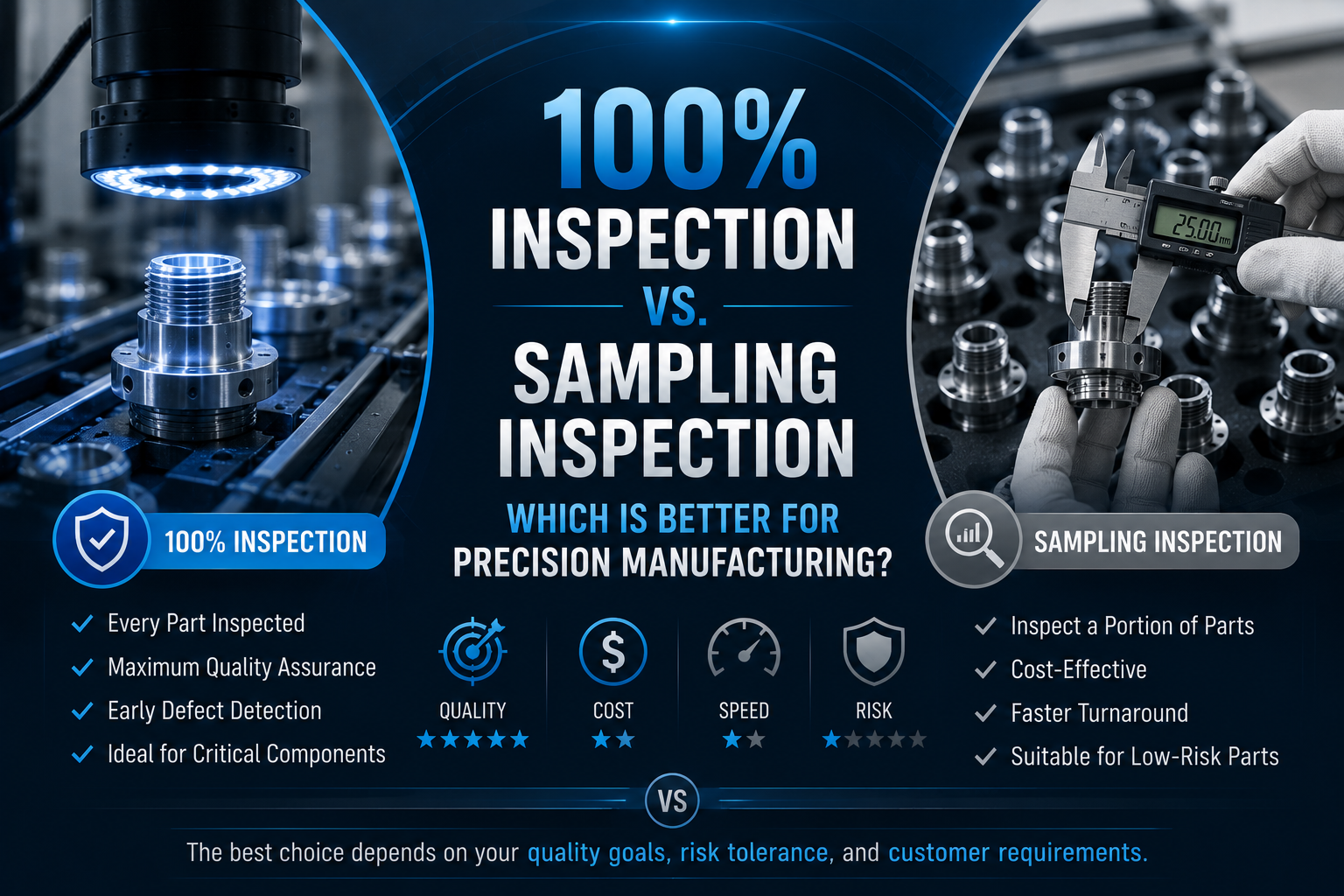
Quality inspection is one of the most critical stages in precision manufacturing. Regardless of how advanced a CNC machining process may be, manufacturers must verify that finished components meet customer specifications before shipment. A well-designed inspection strategy protects both the manufacturer and the customer by reducing defects, improving consistency, and strengthening confidence in the supply chain.
Among the many quality control methods available today, two approaches dominate modern manufacturing: Sampling Inspection and 100% Inspection.
Both methods have clear advantages, and neither is universally superior in every situation. The appropriate choice depends on factors such as production volume, product complexity, customer requirements, industry regulations, and acceptable risk levels.
Understanding the strengths and limitations of each inspection strategy allows manufacturers to design a quality system that balances efficiency, cost, and reliability.
What Is Sampling Inspection?
Sampling inspection is the process of inspecting only a selected number of parts from a production batch rather than examining every individual component.
The sample size is usually determined according to internationally recognized standards or customer requirements. If the inspected samples satisfy the acceptance criteria, the entire production lot is considered acceptable.
Sampling inspection has been widely used for decades because it provides a practical balance between inspection cost and quality assurance.
Typical applications include:
- Medium-volume production
- Stable manufacturing processes
- Low-risk industrial components
- Incoming material inspection
- Supplier quality verification
When manufacturing processes are highly stable and statistically controlled, sampling inspection can provide reliable results with relatively low inspection costs.
Advantages of Sampling Inspection
Sampling inspection offers several important benefits.
Lower Inspection Cost
Since only a portion of products is inspected, manufacturers require fewer inspection resources and less inspection time.
Faster Throughput
Production batches can move more quickly through the inspection process, supporting shorter lead times.
Efficient Use of Resources
Highly trained quality inspectors can focus on evaluating critical characteristics instead of measuring every single component.
Suitable for Stable Processes
When Statistical Process Control (SPC) demonstrates that a manufacturing process is highly capable and consistent, sampling inspection often provides sufficient confidence for many industrial applications.
For these reasons, sampling inspection remains an important part of many quality management systems.
Limitations of Sampling Inspection
Despite its efficiency, sampling inspection has inherent limitations.
The most significant disadvantage is simple:
Not every part is inspected.
This means defective products may still be shipped if they are not included in the inspection sample.
Potential risks include:
- Undetected dimensional variation
- Random production defects
- Machine malfunctions occurring after sampling
- Tool breakage during production
- Surface damage on uninspected parts
- Customer complaints caused by isolated defective components
Although statistical methods reduce these risks, they cannot eliminate them entirely.
For industries requiring extremely high reliability, sampling inspection alone may not provide sufficient assurance.
What Is 100% Inspection?
100% inspection means that every manufactured component is individually examined before shipment.
Instead of evaluating only a representative sample, every single part passes through the inspection process.
Historically, performing 100% inspection manually was expensive, slow, and often impractical.
However, advances in Optical Sorting, Machine Vision, and Automated Inspection Systems have made full inspection both practical and highly efficient for many manufacturing environments.
Modern optical sorting equipment can inspect thousands of precision components every hour while maintaining exceptional consistency.
Advantages of 100% Inspection
Maximum Product Reliability
Every finished component is evaluated before delivery, greatly reducing the possibility that defective products reach customers.
Increased Customer Confidence
Customers gain additional assurance knowing that each shipped component has been inspected individually.
This is especially important for industries with strict quality expectations.
Early Detection of Process Problems
Continuous inspection provides immediate feedback when production begins to drift outside acceptable limits.
Manufacturers can quickly identify:
- Tool wear
- Machine instability
- Fixture movement
- Material inconsistencies
- Programming issues
Early detection prevents small problems from becoming large production losses.
Better Quality Data
Because every part is inspected, manufacturers collect significantly more production data.
This supports:
- Process optimization
- SPC analysis
- Root cause investigations
- Predictive maintenance
- Continuous improvement initiatives
Inspection becomes an important source of manufacturing intelligence rather than simply a quality checkpoint.
Challenges of 100% Inspection
Although 100% inspection offers substantial benefits, it also presents several considerations.
Equipment Investment
Advanced optical sorting systems require initial capital investment.
Manufacturers must evaluate expected production volume and long-term return on investment.
System Maintenance
Inspection equipment requires:
- Camera calibration
- Lighting maintenance
- Software updates
- Regular verification
- Preventive maintenance
Maintaining system accuracy is essential for reliable inspection performance.
Inspection Criteria Development
Successful automated inspection depends on clearly defined quality standards.
Engineers must establish appropriate acceptance criteria to minimize both false rejects and false accepts.
When Should Manufacturers Choose Sampling Inspection?
Sampling inspection remains an effective solution when:
- Production processes are highly stable.
- Product risk is relatively low.
- Customer specifications permit statistical inspection.
- Production quantities are moderate.
- Inspection costs must be carefully controlled.
Many manufacturers successfully combine sampling inspection with SPC to maintain consistent quality while optimizing efficiency.
When Is 100% Inspection the Better Choice?
100% inspection is often preferred when:
- Components have extremely tight tolerances.
- Products are safety-critical.
- Customer quality requirements are exceptionally high.
- Production volumes are very large.
- Defects could result in expensive recalls.
- Products are difficult or impossible to repair after assembly.
- International OEM customers require complete inspection records.
Industries that commonly benefit from 100% inspection include:
- Automotive
- Aerospace
- Medical devices
- Electronics
- Semiconductor equipment
- AI robotics
- Industrial automation
For these applications, the additional investment in automated inspection often provides substantial long-term value.
Optical Sorting Makes 100% Inspection Practical
The widespread adoption of optical sorting has transformed quality assurance in modern manufacturing.
Today’s systems combine:
- High-speed industrial cameras
- Precision optics
- Intelligent lighting
- AI-assisted image analysis
- Automated reject mechanisms
- Digital production records
Together, these technologies allow manufacturers to perform high-speed, highly consistent 100% inspection without creating production bottlenecks.
As optical sorting technology continues to evolve, inspection becomes faster, smarter, and more accurate while requiring less manual intervention.
Combining Both Strategies
Many leading CNC manufacturers do not choose one inspection method exclusively.
Instead, they combine multiple inspection approaches to maximize quality while maintaining efficiency.
A typical quality workflow may include:
- Incoming material inspection
- First Article Inspection (FAI)
- In-process sampling inspection
- CMM verification of critical dimensions
- Optical sorting for final 100% inspection
- Final quality audit before shipment
This layered strategy provides multiple opportunities to detect and eliminate defects before products reach customers.
Conclusion
Sampling inspection and 100% inspection each play important roles in modern precision manufacturing. Sampling inspection remains an efficient and cost-effective solution for stable production environments, while 100% inspection provides the highest level of product verification for demanding applications.
With the advancement of optical sorting and machine vision technology, manufacturers no longer need to choose between inspection quality and production efficiency. Automated 100% inspection enables companies to strengthen customer confidence, reduce quality risks, and build more reliable manufacturing processes.
As industries continue to demand greater precision and traceability, integrating intelligent optical sorting into a comprehensive quality management system will become an increasingly important competitive advantage.