

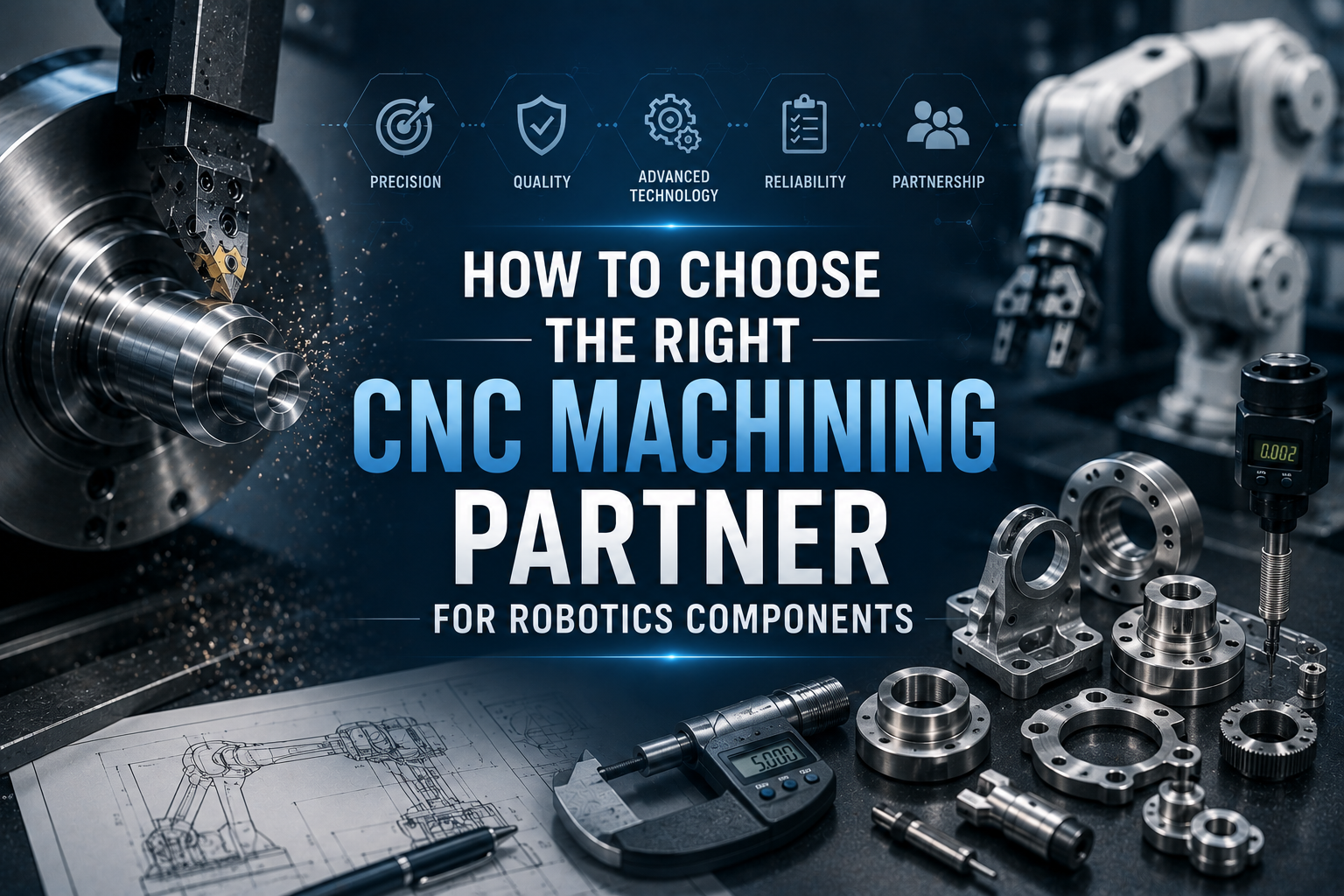
The rapid growth of AI robotics, collaborative robots (cobots), autonomous mobile robots (AMRs), and industrial automation has significantly increased the demand for precision-machined components. Today’s robotic systems require exceptional mechanical accuracy, long-term reliability, and consistent manufacturing quality to perform complex tasks safely and efficiently.
For robotics companies, selecting a CNC machining supplier is about much more than comparing prices. A manufacturing partner becomes an extension of the engineering team, directly influencing product quality, production schedules, and supply chain stability.
Choosing the right supplier at the beginning of a project can reduce development risks, shorten production lead times, and support long-term product success.
Understand Your Component Requirements
Before requesting quotations, manufacturers should clearly define the technical requirements of each component.
Important information includes:
- 2D engineering drawings
- 3D CAD models
- Material specifications
- Surface finish requirements
- Tolerance requirements
- Heat treatment specifications
- Surface coating requirements
- Expected production volume
Providing complete technical documentation allows suppliers to evaluate manufacturability more accurately and prepare realistic quotations.
Well-defined requirements also reduce misunderstandings during production.
Evaluate Precision Machining Capability
Robotics applications often require significantly tighter tolerances than general industrial products.
Ask potential suppliers about their capability to manufacture features such as:
- Precision bearing seats
- Servo motor mounting surfaces
- Gearbox housings
- Precision shafts
- Sensor mounting brackets
- Structural aluminum components
A qualified supplier should be able to explain:
- Typical machining tolerances
- Machine capabilities
- Inspection equipment
- Process controls
- Previous project experience
The ability to consistently maintain precision is far more valuable than simply achieving it once.
Review Manufacturing Equipment
Modern CNC equipment directly influences production quality and efficiency.
When evaluating suppliers, consider whether they utilize:
- CNC Turning Centers
- CNC Machining Centers
- Multi-axis machining
- Swiss-type lathes
- Automatic bar feeders
- Robotic automation
- Tool monitoring systems
Advanced equipment improves repeatability while supporting more complex component geometries.
Production capacity should also match future business growth.
Examine Quality Assurance Systems
Quality management is one of the most important selection criteria.
A reliable robotics supplier should implement comprehensive quality procedures covering every production stage.
Key elements include:
Material Verification
Incoming raw materials should be inspected and verified before machining begins.
In-Process Inspection
Critical dimensions should be monitored continuously during production.
Final Inspection
Completed products should undergo comprehensive dimensional verification before shipment.
Optical Sorting
For high-volume robotic components, automated optical sorting supports consistent 100% inspection.
Traceability
Manufacturers should maintain complete production records, including material certifications, inspection reports, and batch information.
These systems reduce manufacturing risks while improving customer confidence.
Engineering Support Matters
A strong CNC supplier contributes more than manufacturing services.
Engineering support may include:
- Design for Manufacturability (DFM)
- Material recommendations
- Cost optimization
- Process improvement
- Tolerance review
- Prototype development
Experienced engineers often identify opportunities to simplify production while improving quality and reducing costs.
Early collaboration between customer and manufacturer usually produces better long-term results.
Prototype Capability Accelerates Development
Most robotics projects begin with prototype production.
A supplier capable of supporting both prototypes and mass production provides significant advantages.
Benefits include:
- Faster product validation
- Simplified engineering communication
- Reduced supplier transition risks
- Improved production consistency
- Shorter time to market
Maintaining the same supplier throughout product development also improves knowledge retention.
Production Capacity for Future Growth
Many robotics companies begin with relatively small production quantities.
However, successful products often experience rapid growth.
Manufacturers should therefore evaluate whether suppliers can scale production efficiently.
Consider factors such as:
- Machine availability
- Workforce capacity
- Automation capability
- Quality control resources
- Production scheduling
- Supply chain management
Scalable manufacturing reduces future supplier changes as demand increases.
Communication Builds Successful Partnerships
Technical capability alone is not enough.
Successful long-term partnerships also depend on effective communication.
Reliable suppliers should provide:
- Prompt technical responses
- Transparent production updates
- Engineering collaboration
- Clear documentation
- Rapid issue resolution
Strong communication helps prevent delays while improving project efficiency.
International customers particularly value suppliers capable of communicating effectively throughout every stage of production.
Global Supply Chain Reliability
Supply chain stability has become increasingly important.
Manufacturers should evaluate:
- On-time delivery performance
- Material sourcing capability
- Inventory management
- Export experience
- Packaging standards
- Logistics support
Reliable delivery performance often becomes just as important as machining quality itself.
Consistent production allows customers to maintain efficient manufacturing operations.
Questions to Ask Before Selecting a Supplier
Before making a final decision, robotics companies should consider asking:
- Do you specialize in precision CNC machining?
- What industries do you currently serve?
- What tolerance levels can you consistently maintain?
- What inspection equipment do you use?
- Do you offer optical sorting or 100% inspection?
- Can you support prototype and production volumes?
- How do you ensure traceability?
- What certifications does your company hold?
- How do you manage continuous improvement?
The answers provide valuable insight into a supplier’s long-term manufacturing capability.
Conclusion
Selecting the right CNC machining partner is a strategic decision that extends far beyond manufacturing cost. Precision capability, quality management, engineering expertise, inspection technology, communication, and production scalability all contribute to the success of robotics products.
As AI robotics continues to expand across global industries, manufacturers that combine advanced CNC machining with rigorous quality assurance and intelligent inspection systems will become increasingly valuable partners. Companies that choose the right manufacturing partner today will be better positioned to deliver innovative, reliable, and competitive robotic solutions in the years ahead.