

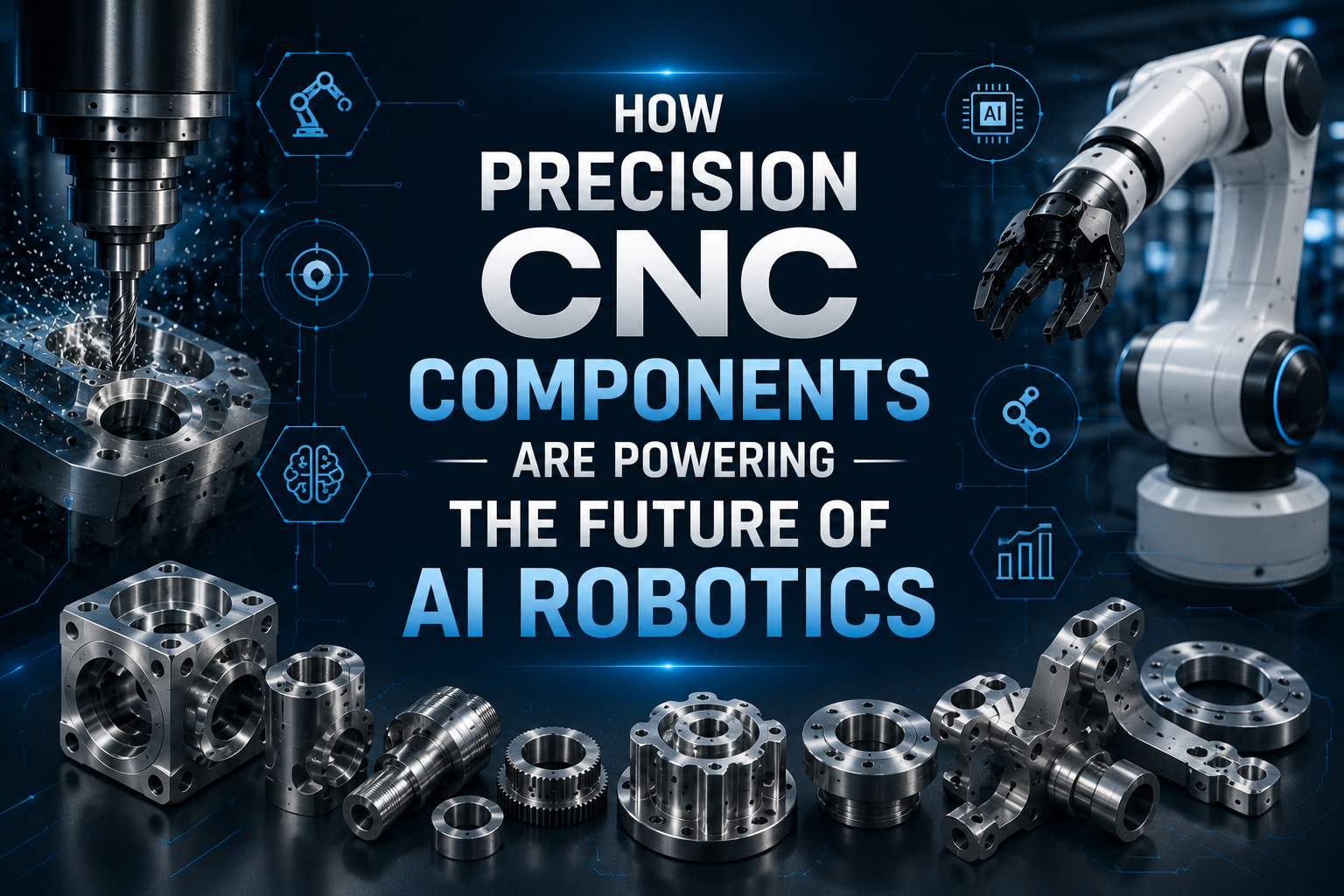
Artificial Intelligence (AI) is transforming industries around the world, but software alone cannot build intelligent machines. Behind every humanoid robot, collaborative robot (cobot), autonomous mobile robot (AMR), and industrial automation system lies a complex mechanical structure composed of hundreds of precision-engineered components.
While AI enables robots to think, analyze, and make decisions, precision mechanical parts enable them to move accurately, operate reliably, and perform consistently.
As the global robotics market continues to expand, the demand for high-quality CNC-machined components is growing rapidly. Manufacturers capable of producing precision mechanical parts with exceptional consistency are becoming essential partners in the AI robotics supply chain.
The Rise of AI Robotics
Recent advances in artificial intelligence, machine learning, computer vision, and sensor technology have accelerated the development of intelligent robotic systems.
Modern robots are now capable of:
- Walking independently
- Recognizing objects
- Performing delicate assembly operations
- Assisting medical professionals
- Transporting materials autonomously
- Collaborating safely with humans
These capabilities require far more than advanced software.
Every movement depends on precisely manufactured mechanical components working together with electronic systems and intelligent control algorithms.
Without reliable mechanical accuracy, even the most advanced AI software cannot achieve stable robotic performance.
Why Precision Matters
Unlike many traditional industrial products, robotic systems involve continuous motion.
Every joint rotates.
Every actuator moves repeatedly.
Every transmission experiences constant mechanical loading.
Small dimensional variations that may be acceptable in other industries can significantly affect robotic performance.
Precision influences:
- Motion accuracy
- Position repeatability
- Load capacity
- Noise levels
- Energy efficiency
- Component lifespan
Even a deviation of only a few microns may create excessive friction, vibration, or premature wear within robotic assemblies.
This is why robotics manufacturers require machining partners capable of maintaining extremely tight tolerances throughout production.
Common CNC Components Used in AI Robots
Modern robots contain hundreds of precision-machined parts.
Typical examples include:
Structural Components
- Aluminum frames
- Robot arm housings
- Mounting brackets
- Base structures
These components provide strength while minimizing overall weight.
Rotary Components
Many robotic systems rely on rotating mechanical assemblies.
Examples include:
- Precision shafts
- Drive hubs
- Bearing seats
- Coupling components
- Gear housings
These parts require exceptional concentricity and dimensional stability.
Motion System Components
Smooth movement depends on accurately manufactured transmission components.
These include:
- Ball screw housings
- Linear guide supports
- Servo motor mounts
- Precision spacers
- Timing pulley assemblies
Proper machining directly affects positioning accuracy and operational efficiency.
Sensor Mounting Components
AI robots depend heavily on sensors.
Precision brackets and mounting components ensure accurate positioning of:
- Cameras
- LiDAR sensors
- Force sensors
- Vision systems
- Laser measurement equipment
Even slight positioning errors may reduce sensing accuracy.
Materials Used in Robotics Manufacturing
Selecting appropriate materials is equally important.
Robotic applications often require balancing weight, strength, durability, and corrosion resistance.
Common materials include:
- Aluminum alloys
- Stainless steel
- Carbon steel
- Titanium
- Brass
- Engineering plastics
Each material offers different advantages depending on the application.
For example, aluminum provides lightweight construction, while stainless steel offers superior corrosion resistance for demanding environments.
Tight Tolerances Support Reliable Motion
Many robotic components require machining tolerances measured in microns.
Critical characteristics include:
- Diameter accuracy
- Flatness
- Parallelism
- Perpendicularity
- Surface roughness
- Concentricity
- Roundness
Maintaining these tolerances ensures proper fit between bearings, gears, motors, and moving assemblies.
Reliable dimensional accuracy also reduces vibration and extends component service life.
Surface Quality Is Equally Important
Surface finish affects far more than appearance.
High-quality surface machining contributes to:
- Lower friction
- Improved lubrication
- Reduced wear
- Better corrosion resistance
- Higher fatigue strength
- Improved assembly quality
Many robotic manufacturers specify precise surface roughness values to optimize long-term performance.
Consistent machining processes help achieve these demanding requirements.
Quality Assurance in Robotics Manufacturing
Because robotic systems often perform safety-critical tasks, quality requirements are extremely strict.
Manufacturers commonly implement:
- Incoming material inspection
- First Article Inspection (FAI)
- In-process inspection
- Coordinate Measuring Machine (CMM) verification
- Optical Sorting
- 100% Inspection
- Complete traceability
These quality control methods ensure every component meets customer specifications before assembly.
Reliable inspection becomes especially important for high-volume robotic production.
Preparing for Future Robotics
The robotics industry is evolving rapidly.
Future developments include:
- Humanoid robots
- Collaborative robots
- Medical robots
- Warehouse automation
- Service robots
- Agricultural robots
- Autonomous logistics systems
Each new generation requires increasingly sophisticated precision components.
Manufacturers capable of combining CNC machining, intelligent inspection, automation, and continuous improvement will be well positioned to support this growing market.
Conclusion
Artificial intelligence may represent the “brain” of modern robotics, but precision mechanical components remain the foundation that enables intelligent machines to function reliably.
As robotics technology advances, demand for high-quality CNC machining will continue to grow. Manufacturers that deliver tight tolerances, superior surface quality, advanced inspection capabilities, and consistent production will play an increasingly important role in the global AI robotics supply chain.
By investing in precision manufacturing and advanced quality assurance, CNC manufacturers are not simply producing components—they are helping build the next generation of intelligent machines.