

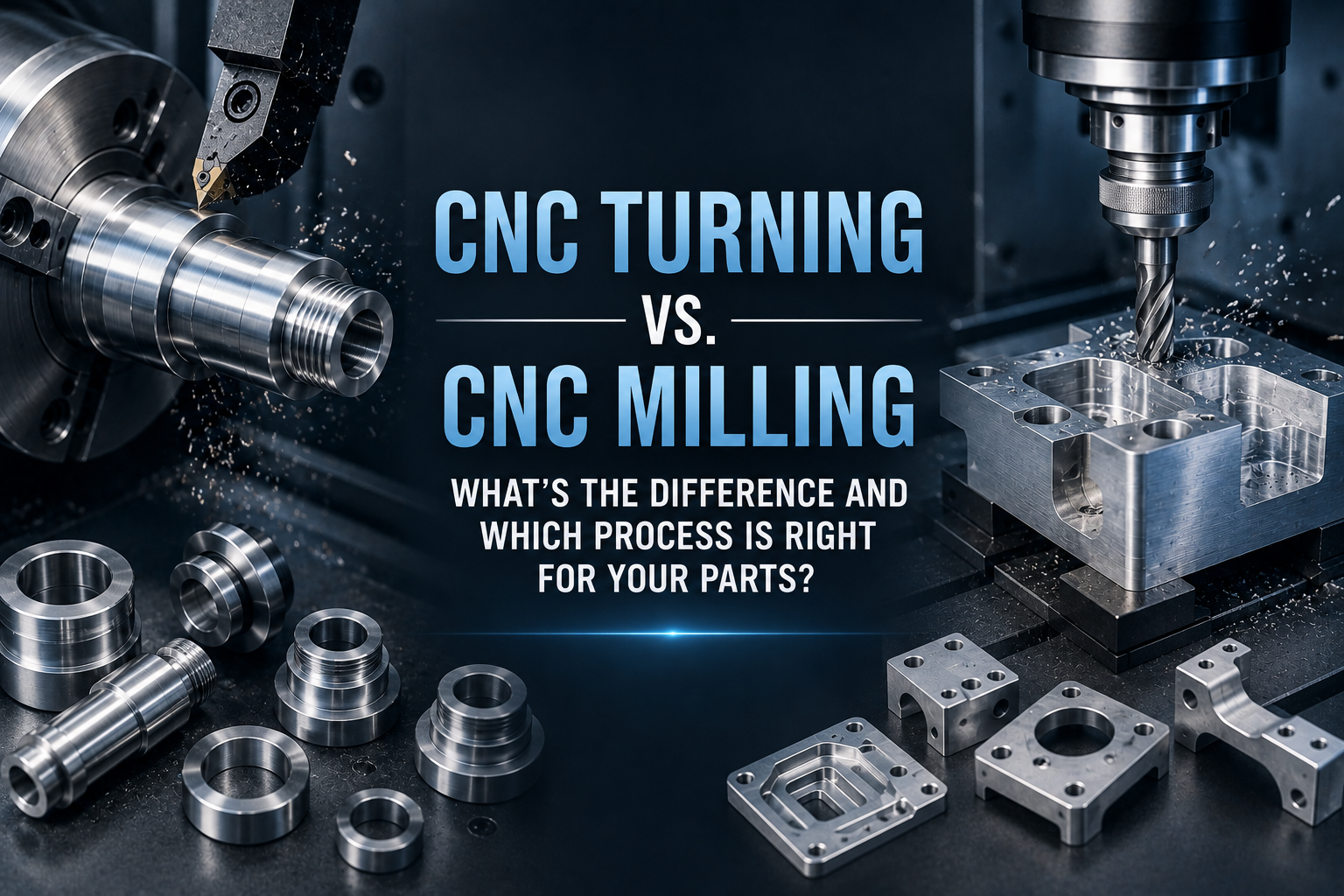
Selecting the appropriate machining process is one of the most important decisions in product development. The manufacturing method influences not only the final component quality, but also production cost, machining efficiency, lead time, and long-term product performance.
Among all CNC machining technologies, CNC Turning and CNC Milling are the two most widely used processes.
Although both rely on computer numerical control (CNC) technology to produce precision components, they operate differently and are optimized for different part geometries.
Understanding the strengths of each process helps engineers and purchasing professionals choose the most efficient manufacturing solution.
Understanding CNC Turning
CNC turning removes material by rotating the workpiece while stationary cutting tools shape the outside or inside diameter.
Because the material rotates around its center axis, turning is ideal for producing cylindrical or rotationally symmetrical components.
Common turned parts include:
- Shafts
- Bushings
- Pins
- Sleeves
- Rollers
- Spacers
- Hydraulic fittings
- Valve components
- Bearing seats
Modern CNC lathes can perform multiple operations within one setup, providing excellent accuracy and repeatability.
Understanding CNC Milling
CNC milling operates differently.
Instead of rotating the workpiece, the cutting tool rotates while the workpiece remains securely fixed.
This allows machining from multiple directions and makes milling suitable for highly complex geometries.
Typical milled components include:
- Aluminum housings
- Mounting brackets
- Heat sinks
- Robot arm structures
- Fixture plates
- Electronic enclosures
- Precision bases
- Mold components
Modern machining centers frequently support 3-axis, 4-axis, and 5-axis machining for increasingly sophisticated products.
Key Differences Between CNC Turning and CNC Milling
| Feature | CNC Turning | CNC Milling |
|---|---|---|
| Workpiece Movement | Rotates | Stationary |
| Cutting Tool | Mostly stationary | Rotates |
| Best Part Shape | Cylindrical | Prismatic and complex |
| Production Speed | Very high for round parts | High for complex geometries |
| Typical Features | Shafts, threads, grooves | Pockets, slots, holes, contours |
| Material Removal | Around center axis | Multi-directional |
| Production Cost | Lower for rotational parts | More economical for complex shapes |
Although the technologies differ, many precision components require both processes during manufacturing.
When CNC Turning Is the Better Choice
Turning is generally preferred when components have rotational symmetry.
Examples include:
- Motor shafts
- Bearing journals
- Hydraulic pistons
- Precision pins
- Threaded connectors
- Couplings
- Bushings
Advantages include:
- Faster machining cycles
- Lower production costs
- Excellent concentricity
- Outstanding surface finish
- Superior dimensional consistency
For large production volumes, CNC turning offers exceptional efficiency.
When CNC Milling Is the Better Choice
Milling becomes the preferred solution when products contain complex three-dimensional features.
Typical applications include:
- Robot structural frames
- Medical instrument housings
- Aerospace brackets
- Electronic enclosures
- Automation fixtures
- Camera mounting systems
Milling easily produces:
- Flat surfaces
- Deep pockets
- Precision slots
- Complex contours
- Irregular geometries
- Multi-face machining
Advanced 5-axis machining further expands manufacturing flexibility.
Why Many Parts Require Both Processes
Modern precision components rarely consist of simple geometries.
Many products combine cylindrical features with complex milled surfaces.
Examples include:
- Servo motor shafts with keyways
- Robot joint components
- Gearbox housings
- Precision valve bodies
- Medical device assemblies
- Aerospace actuators
A typical manufacturing sequence may involve:
- CNC Turning for the primary cylindrical geometry.
- CNC Milling for mounting holes, slots, and precision surfaces.
- Surface treatment.
- Optical inspection.
- Final quality verification.
Combining turning and milling reduces setup errors while improving dimensional accuracy.
Materials Compatible with Both Processes
Both CNC turning and milling support a wide variety of engineering materials.
Common choices include:
Aluminum Alloys
Ideal for robotics, aerospace, and electronics because of their excellent machinability and low weight.
Stainless Steel
Suitable for corrosion-resistant applications such as medical devices, food equipment, and industrial automation.
Carbon Steel
Provides high strength for shafts, mechanical components, and structural parts.
Brass
Frequently used for electrical connectors, pneumatic fittings, and valve components.
Engineering Plastics
Materials such as POM, PEEK, Nylon, and PTFE provide lightweight, wear-resistant, and chemically resistant solutions for specialized applications.
Quality Assurance Across Both Processes
Regardless of the machining method, consistent quality depends on a structured inspection process.
Typical quality control procedures include:
- Incoming material inspection
- First Article Inspection (FAI)
- In-process inspection
- Coordinate Measuring Machine (CMM) verification
- Surface roughness measurement
- Thread inspection
- Optical sorting
- Final quality inspection
For high-volume production, optical sorting systems provide efficient 100% inspection, helping manufacturers reduce defects while maintaining high productivity.
Choosing the Right Manufacturing Partner
When selecting a CNC supplier, customers should look beyond individual machining capabilities.
An ideal manufacturing partner offers:
- CNC turning expertise
- CNC milling expertise
- Combined turning and milling services
- Engineering support
- Material knowledge
- Advanced inspection equipment
- Optical sorting capability
- Flexible production capacity
- Reliable delivery performance
Working with a supplier capable of integrating multiple machining processes simplifies production while improving quality consistency.
The Future of Precision Machining
Manufacturing continues to evolve through automation, digitalization, and intelligent production systems.
Future developments include:
- Multi-tasking machining centers
- Turn-mill machines
- AI-assisted machining optimization
- Digital twins
- Predictive maintenance
- Smart quality inspection
- Fully connected manufacturing systems
These innovations reduce production time while improving quality and operational efficiency.
Conclusion
CNC turning and CNC milling are complementary manufacturing technologies rather than competing processes. Turning excels at producing high-precision cylindrical components, while milling provides exceptional flexibility for complex geometries. Many advanced products—including robotics, medical devices, aerospace equipment, and industrial automation systems—require both processes to achieve optimal performance.
By partnering with a manufacturer that offers integrated CNC turning, CNC milling, advanced quality assurance, and automated optical inspection, companies can improve product quality, shorten lead times, and build a more reliable supply chain for future growth.