

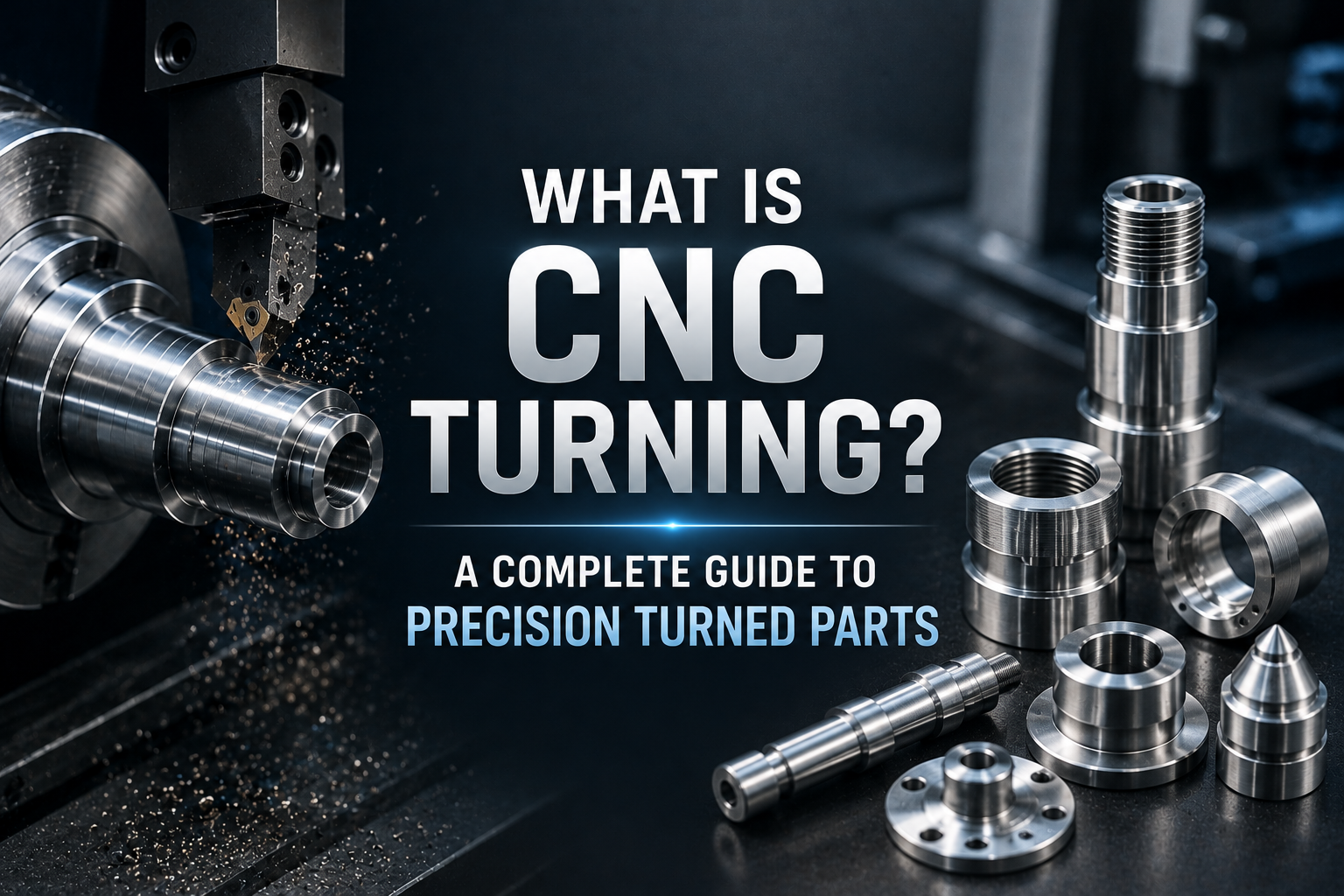
CNC turning is one of the most widely used manufacturing processes in modern precision engineering. From tiny electronic connectors to complex robotic shafts and high-performance aerospace components, CNC turning enables manufacturers to produce highly accurate cylindrical parts with excellent repeatability and efficiency.
As industries continue demanding tighter tolerances, shorter lead times, and more consistent quality, CNC turning has become an essential production technology for manufacturers worldwide.
Whether producing prototypes or millions of identical components, CNC turning delivers the precision and reliability required by today’s advanced manufacturing industries.
What Is CNC Turning?
CNC turning is a machining process in which a workpiece rotates while stationary cutting tools remove material to create the desired shape.
Unlike CNC milling, where the cutting tool rotates around a stationary workpiece, CNC turning rotates the material itself.
Because of this, turning is particularly effective for producing round or cylindrical components.
Typical products include:
- Precision shafts
- Bushings
- Sleeves
- Pins
- Spacers
- Connectors
- Threaded components
- Valve parts
- Hydraulic fittings
- Robot drive components
Modern CNC lathes can achieve exceptional accuracy while maintaining excellent production efficiency.
How the CNC Turning Process Works
Although every project is unique, the turning process generally follows several key steps.
Material Preparation
Production begins with raw material in the form of:
- Round bars
- Tubes
- Forgings
- Cast blanks
Materials are selected according to customer specifications and product performance requirements.
Workpiece Clamping
The material is securely held using:
- Hydraulic chucks
- Collets
- Custom fixtures
Proper clamping minimizes vibration and maintains dimensional stability throughout machining.
CNC Programming
Engineers generate machining programs using CAD/CAM software.
Programs control:
- Spindle speed
- Feed rate
- Tool path
- Cutting depth
- Tool changes
- Machining sequence
Optimized programming improves machining efficiency while extending tool life.
Precision Machining
During machining, the workpiece rotates while cutting tools remove material.
Common turning operations include:
- Facing
- External turning
- Internal boring
- Grooving
- Thread cutting
- Chamfering
- Parting
- Drilling
- Reaming
- Knurling
Multiple operations are often completed within a single setup to improve accuracy and reduce production time.
Advantages of CNC Turning
CNC turning offers numerous advantages compared with conventional machining methods.
Excellent Dimensional Accuracy
Modern CNC lathes consistently produce components with extremely tight tolerances.
This precision is essential for:
- Bearings
- Hydraulic systems
- Robotics
- Medical equipment
- Aerospace assemblies
Outstanding Repeatability
Computer-controlled machining ensures every component is produced according to identical machining programs.
This repeatability supports:
- High-volume production
- Stable quality
- Reduced variation
- Lower inspection costs
High Production Efficiency
Automatic tool changers, bar feeders, and robotic automation allow continuous production with minimal manual intervention.
This increases:
- Productivity
- Machine utilization
- Cost efficiency
Superior Surface Finish
Optimized cutting parameters and high-quality tooling produce excellent surface finishes.
Good surface quality improves:
- Wear resistance
- Assembly performance
- Corrosion resistance
- Product appearance
Materials Commonly Used in CNC Turning
CNC turning supports a wide variety of engineering materials.
Common examples include:
Aluminum
Lightweight and easy to machine.
Widely used for robotics, electronics, and aerospace applications.
Stainless Steel
Provides excellent corrosion resistance and strength.
Commonly used in medical devices, food equipment, and industrial machinery.
Carbon Steel
Offers high strength with excellent machinability.
Frequently used for mechanical components and structural parts.
Brass
Excellent electrical conductivity and corrosion resistance.
Often used for connectors, fittings, and precision valves.
Engineering Plastics
Materials such as:
- POM
- Nylon
- PTFE
- PEEK
provide low friction, lightweight performance, and excellent chemical resistance.
Industries That Depend on CNC Turning
Precision turned parts are essential across numerous industries.
AI Robotics
Applications include:
- Servo shafts
- Joint housings
- Drive components
- Bearing supports
Automotive
Typical components include:
- Transmission parts
- Steering components
- Fuel system fittings
- Brake system components
Medical Devices
Medical applications require:
- Surgical instruments
- Implant components
- Precision connectors
where accuracy and cleanliness are critical.
Electronics
Miniaturized electronic products depend on precision-turned:
- Connectors
- Sensor housings
- Fasteners
- Heat dissipation components
Industrial Automation
Factory automation systems use:
- Linear motion components
- Pneumatic fittings
- Precision rollers
- Machine shafts
Quality Control in CNC Turning
High-quality machining requires comprehensive inspection throughout production.
Manufacturers commonly implement:
First Article Inspection (FAI)
Verifies the first completed part before full production begins.
In-Process Inspection
Critical dimensions are monitored continuously.
Coordinate Measuring Machine (CMM)
Complex geometries are verified using precision measurement equipment.
Optical Sorting
For high-volume production, optical sorting systems automatically inspect:
- Surface defects
- Burrs
- Dimensional variation
- Missing features
Automated inspection supports consistent 100% quality verification.
Choosing the Right CNC Turning Partner
When selecting a manufacturing supplier, customers should evaluate:
- Precision capability
- Material expertise
- Engineering support
- Inspection technology
- Production capacity
- Quality management
- Delivery performance
- Experience in target industries
A reliable manufacturing partner contributes not only to product quality but also to long-term supply chain stability.
The Future of CNC Turning
CNC turning continues evolving through:
- Multi-axis machining
- Live tooling
- Automation
- AI-assisted programming
- Digital manufacturing
- Smart quality inspection
- Real-time process monitoring
These innovations improve manufacturing efficiency while supporting increasingly complex product designs.
Manufacturers that invest in advanced machining technology and intelligent quality systems will remain competitive in the rapidly changing global manufacturing landscape.
Conclusion
CNC turning remains one of the most important manufacturing technologies for producing high-precision cylindrical components. Its ability to deliver exceptional accuracy, repeatability, and production efficiency makes it indispensable across industries including robotics, automotive, aerospace, electronics, and medical devices.
As manufacturing continues embracing automation and smart factory technologies, CNC turning will remain a cornerstone of precision engineering. Companies that combine advanced machining capabilities with rigorous quality assurance and automated inspection are well positioned to meet the growing demands of global OEM customers.