

In the global manufacturing industry, customers expect more than precision-machined components—they expect reliable production systems that consistently deliver quality, efficiency, and traceability. Whether serving the automotive, electronics, medical, aerospace, or industrial automation sectors, manufacturers must demonstrate their ability to produce parts that meet stringent quality requirements every time.
This is where ISO 9001 plays a critical role.
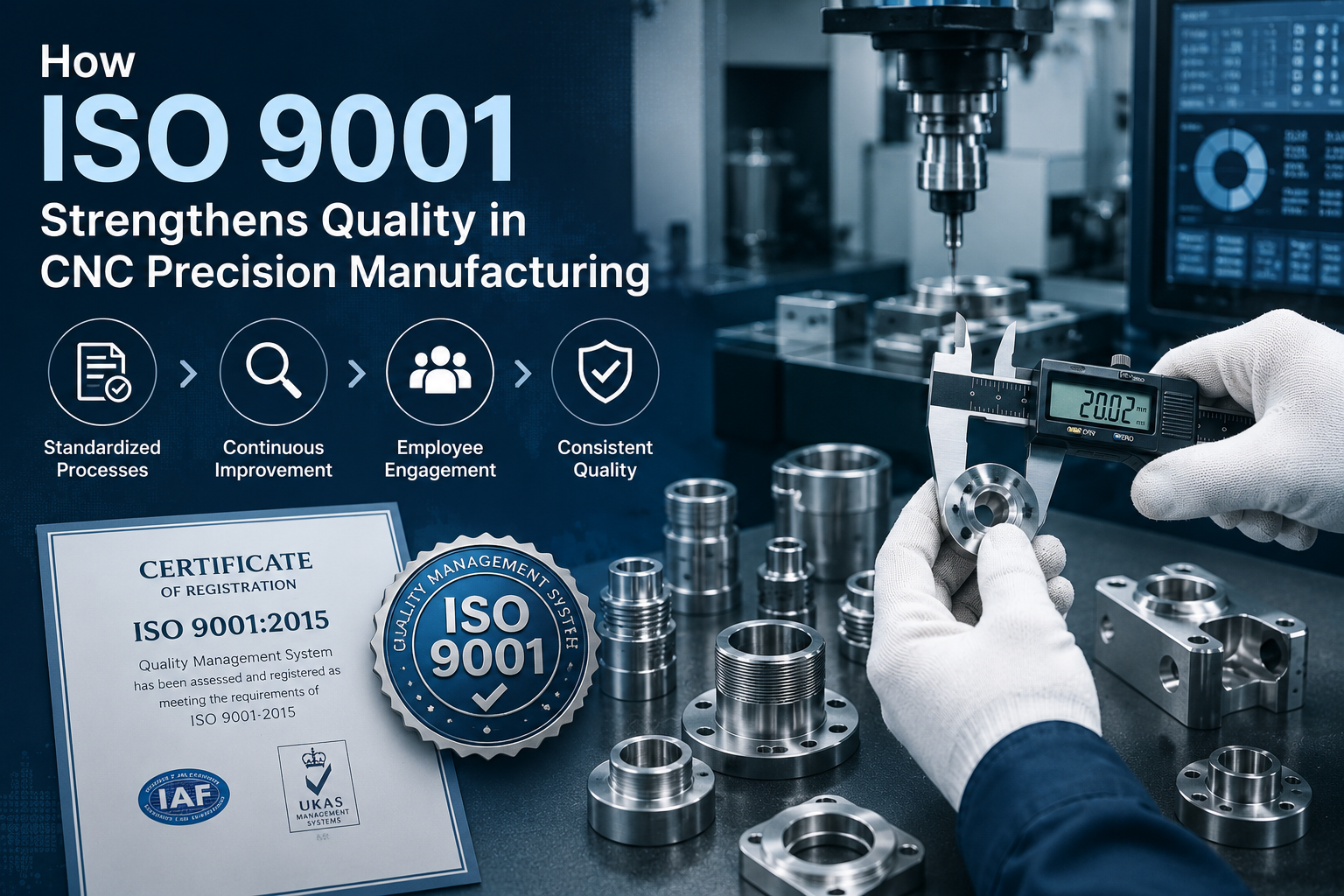
ISO 9001 is an internationally recognized Quality Management System (QMS) standard that provides manufacturers with a structured framework for managing processes, controlling quality, and driving continuous improvement. Rather than focusing solely on final product inspection, ISO 9001 emphasizes systematic management throughout the entire manufacturing process.
For CNC precision machining companies, implementing ISO 9001 is more than achieving certification—it is about establishing a culture of consistency, accountability, and customer satisfaction.
Understanding the Purpose of ISO 9001
ISO 9001 was developed to help organizations build repeatable, measurable, and continuously improving business processes.
Instead of relying on individual experience or informal procedures, the standard encourages manufacturers to create documented workflows that define how work should be performed, monitored, and improved.
In a CNC machining environment, this means every stage—from receiving customer drawings to shipping finished products—follows standardized procedures designed to minimize variation and reduce the risk of errors.
The result is a more predictable manufacturing process capable of delivering consistent product quality across every production batch.
Standardized Processes Reduce Manufacturing Risks
One of the greatest advantages of ISO 9001 is process standardization.
Without standardized procedures, production quality may depend heavily on operator experience or individual work habits. While skilled employees are valuable, relying solely on personal expertise can introduce unnecessary variability.
ISO 9001 encourages manufacturers to document key production activities such as:
- Contract review
- Engineering drawing verification
- Material receiving inspection
- CNC machining procedures
- Tool management
- Equipment maintenance
- Inspection methods
- Packaging standards
- Shipping procedures
Documented processes help ensure that every employee follows the same quality expectations, regardless of production volume or shift schedules.
Risk-Based Thinking Improves Preventive Quality Management
Modern ISO 9001 emphasizes risk-based thinking rather than simply reacting to problems after they occur.
Manufacturers are encouraged to identify potential risks before production begins and establish preventive measures that reduce the likelihood of defects.
Examples include:
- Reviewing complex part geometries before machining
- Evaluating material availability and specifications
- Identifying critical dimensions requiring additional inspection
- Monitoring machine calibration schedules
- Planning backup production resources
- Verifying tooling conditions before production
This proactive approach reduces downtime, minimizes scrap, and helps maintain stable production performance.
Documentation Creates Complete Traceability
Manufacturing traceability has become increasingly important as customers demand greater transparency throughout the supply chain.
ISO 9001 encourages organizations to maintain accurate records covering every stage of production.
Typical documentation may include:
- Material certificates
- Inspection reports
- Machine maintenance records
- Calibration certificates
- Operator training records
- Process verification documents
- Corrective action reports
These records enable manufacturers to quickly investigate quality concerns, identify root causes, and implement effective corrective actions when necessary.
Traceability also provides customers with additional confidence that every product has been manufactured under controlled conditions.
Customer Satisfaction Is the Central Objective
Unlike traditional inspection-focused quality systems, ISO 9001 places strong emphasis on customer satisfaction.
Manufacturers are expected to understand customer requirements clearly before production begins and continually evaluate whether those expectations are being met.
This includes:
- Reviewing customer specifications carefully
- Monitoring delivery performance
- Responding promptly to customer feedback
- Managing complaints systematically
- Improving communication throughout the project lifecycle
By actively listening to customers and incorporating feedback into operational improvements, manufacturers can strengthen long-term business relationships and increase customer loyalty.
Continuous Improvement Drives Long-Term Success
One of the defining principles of ISO 9001 is continuous improvement.
Quality management should never remain static. Instead, organizations are encouraged to regularly evaluate performance and identify opportunities for improvement.
Common improvement activities include:
- Internal quality audits
- Production performance analysis
- Root cause investigations
- Employee training programs
- Equipment upgrades
- Process optimization
- Preventive maintenance improvements
Even small improvements accumulated over time can significantly increase productivity, reduce manufacturing costs, and improve product consistency.
Supporting Advanced Manufacturing Technologies
As manufacturing continues to evolve toward smart factories and digital production, ISO 9001 provides a strong management foundation for adopting new technologies.
Manufacturers increasingly integrate:
- CNC automation
- Optical sorting systems
- Vision inspection technology
- Statistical process monitoring
- Digital production records
- Manufacturing execution systems (MES)
These technologies enhance quality management by providing more accurate data, faster inspection, and greater production transparency.
An ISO-based management system helps organizations integrate these innovations while maintaining controlled and standardized processes.
Building Long-Term Trust Through Quality Management
For many international buyers, selecting a manufacturing partner involves more than evaluating price and machining capability.
They also consider:
- Quality consistency
- Communication efficiency
- Production stability
- Delivery reliability
- Traceability
- Continuous improvement capability
ISO 9001 demonstrates that a manufacturer has established structured management practices designed to consistently meet customer expectations.
Although certification alone does not guarantee flawless products, it reflects an organization’s commitment to disciplined quality management and long-term operational excellence.
Conclusion
ISO 9001 has become an essential framework for modern CNC precision manufacturing. By standardizing processes, promoting risk-based thinking, strengthening traceability, and encouraging continuous improvement, manufacturers can build more reliable operations while delivering greater value to customers.
As global industries continue to demand higher precision, faster lead times, and increased quality assurance, ISO 9001 remains one of the most effective tools for supporting sustainable manufacturing success and building lasting customer confidence.