

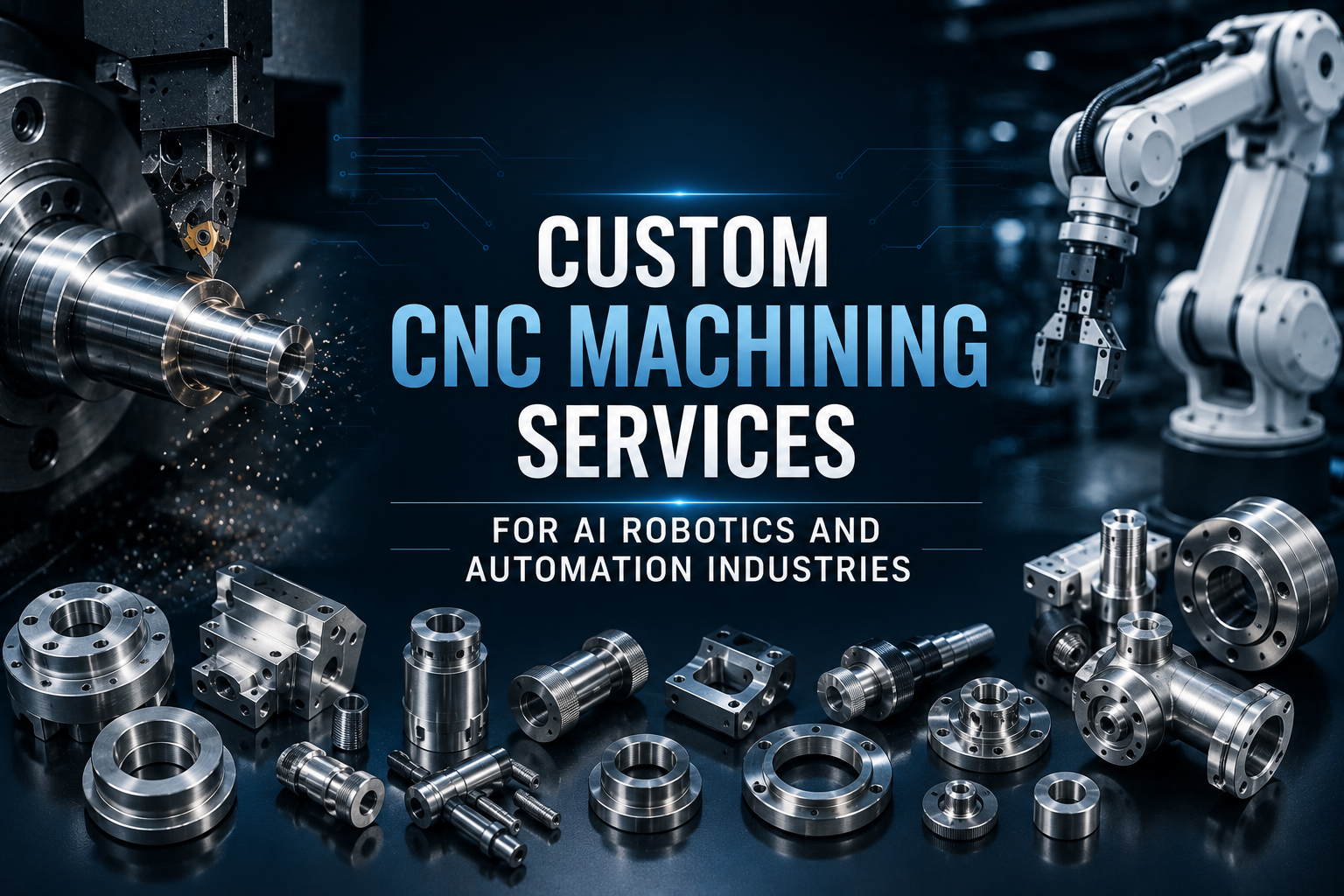
The rapid advancement of artificial intelligence and industrial automation is reshaping manufacturing worldwide. From humanoid robots and collaborative robots (cobots) to autonomous mobile robots (AMRs) and intelligent production equipment, modern robotic systems require an increasing number of high-precision mechanical components.
Unlike standard industrial parts, robotic components often involve complex geometries, tight tolerances, lightweight structures, and demanding performance requirements. These challenges make custom CNC machining one of the most important manufacturing solutions for robotics companies developing next-generation products.
Whether producing prototypes for research and development or scaling to mass production, precision CNC machining provides the flexibility, accuracy, and consistency required to support today’s rapidly evolving robotics industry.
Why Custom CNC Machining Matters
Every robotics project has unique engineering requirements.
Unlike standard catalog components, many robotic parts are designed specifically for a particular application.
Examples include:
- Robot joint housings
- Harmonic drive supports
- Servo motor mounting plates
- Precision gearbox housings
- Structural aluminum frames
- End-effector components
- Sensor brackets
- Camera mounting systems
- Linear motion supports
Because these parts often cannot be purchased off the shelf, custom CNC machining becomes the preferred manufacturing solution.
Custom manufacturing allows engineers to optimize component geometry, weight, strength, and functionality without being constrained by standardized dimensions.
Supporting Every Stage of Product Development
Robotics development typically progresses through several manufacturing stages.
Concept Validation
Early prototypes allow engineers to verify mechanical designs before large investments are made.
Small production quantities enable rapid design improvements while reducing development costs.
Engineering Prototypes
As product designs mature, manufacturers produce more accurate prototype components that closely resemble final production parts.
These prototypes are commonly used for:
- Functional testing
- Motion analysis
- Structural verification
- Thermal evaluation
- Reliability testing
Precision machining ensures prototype performance accurately reflects future production.
Pilot Production
Pilot production bridges the gap between prototypes and full-scale manufacturing.
Manufacturers evaluate:
- Production stability
- Process capability
- Inspection procedures
- Assembly efficiency
Lessons learned during pilot production improve future manufacturing performance.
Mass Production
Once products enter commercial production, consistency becomes the primary objective.
Manufacturers focus on:
- Stable machining processes
- Repeatable quality
- Production efficiency
- Automated inspection
- On-time delivery
Maintaining identical quality across thousands of components becomes essential.
Materials for Robotics Applications
Material selection directly affects robotic performance.
Manufacturers commonly machine:
Aluminum Alloys
Preferred for lightweight structural components.
Applications include:
- Robot arms
- Base frames
- Sensor brackets
- Electronic housings
Stainless Steel
Used where corrosion resistance and strength are required.
Applications include:
- Precision shafts
- Mounting hardware
- Bearing supports
- High-load components
Titanium
Chosen for applications requiring high strength with reduced weight.
Often used in advanced robotics and aerospace systems.
Engineering Plastics
Materials such as POM, PEEK, and Nylon provide:
- Low friction
- Electrical insulation
- Reduced weight
- Excellent wear resistance
These materials are frequently used for bushings, guides, and specialized mechanical components.
Precision Manufacturing for Complex Components
Modern robotics requires increasingly sophisticated machining capabilities.
Typical CNC processes include:
- CNC Turning
- CNC Milling
- 5-Axis Machining
- Thread Milling
- Precision Drilling
- Tapping
- Surface Finishing
- Deburring
These processes allow manufacturers to produce highly complex geometries while maintaining tight dimensional tolerances.
Quality Assurance Throughout Production
Reliable robotic systems begin with reliable manufacturing.
Comprehensive quality assurance includes:
Incoming Material Inspection
Verification of raw materials before production.
First Article Inspection (FAI)
Validation of the initial production sample.
In-Process Inspection
Continuous monitoring of critical dimensions during machining.
Coordinate Measuring Machine (CMM)
Verification of complex geometric tolerances.
Optical Sorting
Automated vision inspection identifies:
- Burrs
- Surface scratches
- Dimensional variation
- Missing features
- Cosmetic defects
Optical sorting supports high-volume production through efficient 100% inspection.
Engineering Collaboration Creates Better Products
Successful robotics manufacturing depends on close cooperation between customers and suppliers.
Engineering collaboration may include:
- Design for Manufacturability (DFM)
- Tolerance optimization
- Material recommendations
- Cost reduction strategies
- Assembly improvements
- Inspection planning
Early communication reduces production risks while improving overall product quality.
Scalable Manufacturing for Growing Businesses
Robotics companies often experience rapid growth.
A qualified manufacturing partner should support:
- Prototype production
- Small batch manufacturing
- Medium-volume production
- High-volume manufacturing
- Long-term supply
Scalable production capacity allows customers to grow without changing suppliers.
Meeting Global Manufacturing Standards
International robotics companies increasingly require suppliers that demonstrate:
- Consistent quality
- Complete traceability
- Process standardization
- Advanced inspection capability
- Reliable delivery
- Continuous improvement
Manufacturers investing in modern CNC technology and intelligent quality management are better prepared to satisfy these global expectations.
Conclusion
Custom CNC machining plays a vital role in the continued growth of AI robotics and industrial automation. From early-stage prototypes to large-scale production, precision manufacturing provides the accuracy, flexibility, and consistency required for advanced robotic systems.
By combining engineering expertise, modern machining technologies, comprehensive quality assurance, and automated optical inspection, manufacturers can support the evolving needs of robotics companies while building long-term partnerships based on quality, reliability, and innovation.