

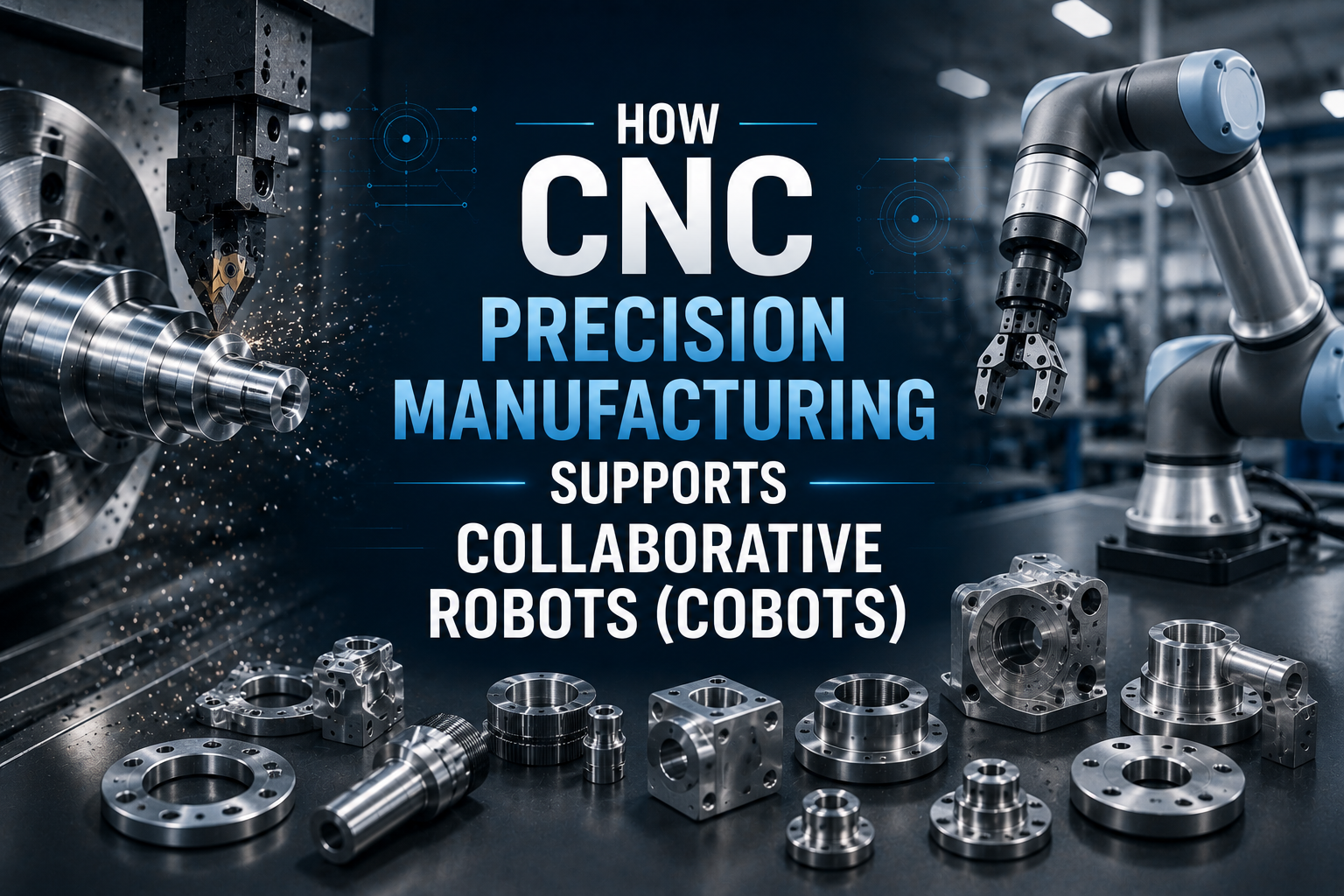
Collaborative robots, commonly known as cobots, are transforming modern manufacturing by enabling humans and robots to work safely side by side. Unlike traditional industrial robots that typically operate inside safety cages, cobots are designed to share workspaces with people, assisting with repetitive, precise, or physically demanding tasks.
The rapid adoption of collaborative robots is changing manufacturing across industries including electronics, automotive, medical devices, semiconductor production, logistics, and consumer goods.
Behind every cobot is a sophisticated combination of artificial intelligence, motion control, sensing technology, and precision mechanical engineering. While software determines how a robot behaves, its mechanical components determine how accurately, safely, and reliably it performs.
This makes CNC precision manufacturing a critical part of the collaborative robotics ecosystem.
What Makes Cobots Different?
Traditional industrial robots are primarily designed for speed and payload capacity.
Collaborative robots are designed with different priorities:
- Safe human interaction
- Flexible deployment
- High positioning accuracy
- Compact size
- Easy programming
- Low maintenance
- Energy efficiency
Because cobots often operate close to human workers, mechanical precision becomes even more important.
Smooth movement, predictable positioning, and reliable operation are essential for workplace safety.
Precision Components Behind Every Cobot
Although collaborative robots appear simple from the outside, they contain numerous high-precision machined components.
Typical CNC-machined parts include:
Joint Housings
Joint housings support bearings, harmonic drives, servo motors, and rotating shafts.
These components require:
- Tight dimensional tolerances
- Excellent concentricity
- Flat mounting surfaces
- High structural rigidity
Accurate machining ensures smooth robotic motion while minimizing vibration.
Motor Mounts
Servo motors generate the motion required by robotic joints.
Motor mounting components must maintain perfect alignment between:
- Motor shafts
- Gearboxes
- Bearings
- Couplings
Even slight misalignment may reduce positioning accuracy and shorten component life.
Precision Shafts
Cobots rely on multiple rotating shafts throughout their motion systems.
Critical requirements include:
- Low runout
- High roundness
- Superior surface finish
- Excellent wear resistance
Precision shafts directly influence robotic repeatability.
Structural Components
Frames and supporting structures must provide:
- Lightweight construction
- High stiffness
- Excellent fatigue resistance
- Stable dimensional accuracy
Aluminum alloys are widely used because they combine low weight with excellent machinability.
Why Tight Tolerances Matter
Cobots frequently perform tasks requiring extremely accurate positioning.
Examples include:
- Electronic assembly
- Machine tending
- Precision screw fastening
- Laboratory automation
- Medical equipment assembly
- Inspection operations
These applications often require positioning repeatability measured in fractions of a millimeter.
Achieving this level of performance begins with precision-manufactured mechanical components.
Poor dimensional accuracy can cause:
- Positioning errors
- Increased backlash
- Excessive vibration
- Higher energy consumption
- Premature wear
Maintaining tight machining tolerances helps ensure smooth and reliable robotic motion.
Surface Finish Affects Performance
Surface quality is often underestimated.
In robotic systems, surface finish influences:
- Bearing performance
- Friction
- Lubrication
- Heat generation
- Wear resistance
- Corrosion protection
Smooth machined surfaces improve mechanical efficiency while extending component service life.
Manufacturers therefore pay close attention to both dimensional accuracy and surface roughness during production.
Quality Assurance for Robotics Manufacturing
Because collaborative robots frequently operate near people, quality requirements are exceptionally strict.
Manufacturers typically implement comprehensive quality management systems covering every production stage.
Inspection processes often include:
Incoming Material Inspection
Raw materials are verified before machining begins to ensure compliance with engineering specifications.
First Article Inspection (FAI)
The first completed component is thoroughly measured before production continues.
This confirms that machining programs, tooling, and fixtures produce the desired results.
In-Process Inspection
Critical dimensions are monitored throughout production to detect process variation before defects occur.
Coordinate Measuring Machine (CMM)
CMM equipment verifies complex geometric features including:
- Position tolerances
- Flatness
- Concentricity
- Parallelism
- Angular relationships
Optical Sorting
High-volume robotic components increasingly undergo automated optical sorting.
Vision inspection systems automatically detect:
- Surface scratches
- Burrs
- Missing features
- Cosmetic defects
- Dimensional deviations
Automated inspection supports 100% quality verification while maintaining high production efficiency.
Supporting Flexible Manufacturing
One major advantage of cobots is flexibility.
Unlike traditional automation systems designed for dedicated production lines, collaborative robots can quickly adapt to changing manufacturing requirements.
CNC precision manufacturers support this flexibility by offering:
- Prototype machining
- Low-volume production
- High-mix manufacturing
- Rapid process changes
- Custom component production
This allows robotics companies to accelerate product development while responding quickly to market demands.
Sustainability Through Precision Manufacturing
Efficient manufacturing also contributes to sustainability.
High-quality machining reduces:
- Material waste
- Scrap rates
- Rework
- Energy consumption
- Equipment downtime
Long-lasting precision components also reduce maintenance requirements throughout a robot’s operational life.
As manufacturers pursue more sustainable production practices, precision manufacturing plays an increasingly important role.
Future Trends in Collaborative Robotics
Collaborative robots continue evolving rapidly.
Emerging developments include:
- AI-assisted motion planning
- Vision-guided robotics
- Mobile collaborative robots
- Human-robot cooperation
- Autonomous production systems
- Smart factory integration
These innovations require even higher levels of machining precision and quality consistency.
Manufacturers investing in advanced CNC technologies, automation, and intelligent inspection systems will be well positioned to support this growing market.
Choosing the Right Manufacturing Partner
For robotics companies, selecting a CNC manufacturing partner involves more than evaluating machining capability.
Important considerations include:
- Precision machining experience
- Tight tolerance capability
- Quality management systems
- Optical inspection technology
- Production scalability
- Material expertise
- Engineering support
- On-time delivery
A reliable manufacturing partner contributes directly to the overall performance and reliability of the finished robotic system.
Conclusion
Collaborative robots are reshaping modern manufacturing by improving productivity, flexibility, and workplace safety. Behind every successful cobot is a network of precisely manufactured mechanical components that enable accurate motion, stable performance, and dependable operation.
CNC precision manufacturing provides the foundation for these advanced robotic systems through high-quality machining, rigorous quality assurance, and automated inspection technologies. As collaborative robotics continues to expand across industries, manufacturers capable of delivering consistent precision and reliable production will become increasingly valuable partners in the global robotics supply chain.